

Blinds for Casement Windows: A Complete Guide
Casement windows are great right up until it’s time to cover them. You get the breeze, the clean glass, and the open view. Then you try to add a blind or shade and run straight into the crank handle, the interior screen, or a frame that’s too shallow for the product you liked in the store.
That’s where most frustration starts. A treatment that works fine on a standard double-hung window can bind on a casement, hit the hardware, or sit so tight that the window becomes awkward to use.
Your Guide to Dressing Casement Windows
A lot of homeowners around West Tennessee call about the same problem. They’ve got a kitchen window over the sink, a breakfast room with side-hinged windows, or a set of casements flanking a picture window. They want privacy and light control, but they don’t want to fight the crank every day.
That’s a fair concern. Casement windows don’t forgive casual measuring or off-the-shelf guessing. The product has to fit the window, but it also has to respect how the window operates. If it doesn’t, the treatment becomes the obstacle instead of the solution.
Homeowners are putting more attention into custom window coverings for exactly that reason. The global curtains and window blinds market reached USD 24.9 billion in 2024, and the residential segment held 73.9% market share, which points to strong homeowner demand for personalized solutions rather than one-size-fits-all options, according to Global Market Insights on the curtains and window blinds market.
Casement windows reward careful product selection. They punish shortcuts.
In real homes, the best result usually comes from starting with the physical limits of the window first, then choosing style second. That sounds backward to some people, but it’s the only way to avoid ordering something pretty that doesn’t function well.
Understanding the Casement Window Challenge
Think of a casement window like a door. It needs room to move, and anything installed too close to that moving path can get in the way. That’s the easiest way to understand why blinds for casement windows need a different approach from standard window coverings.
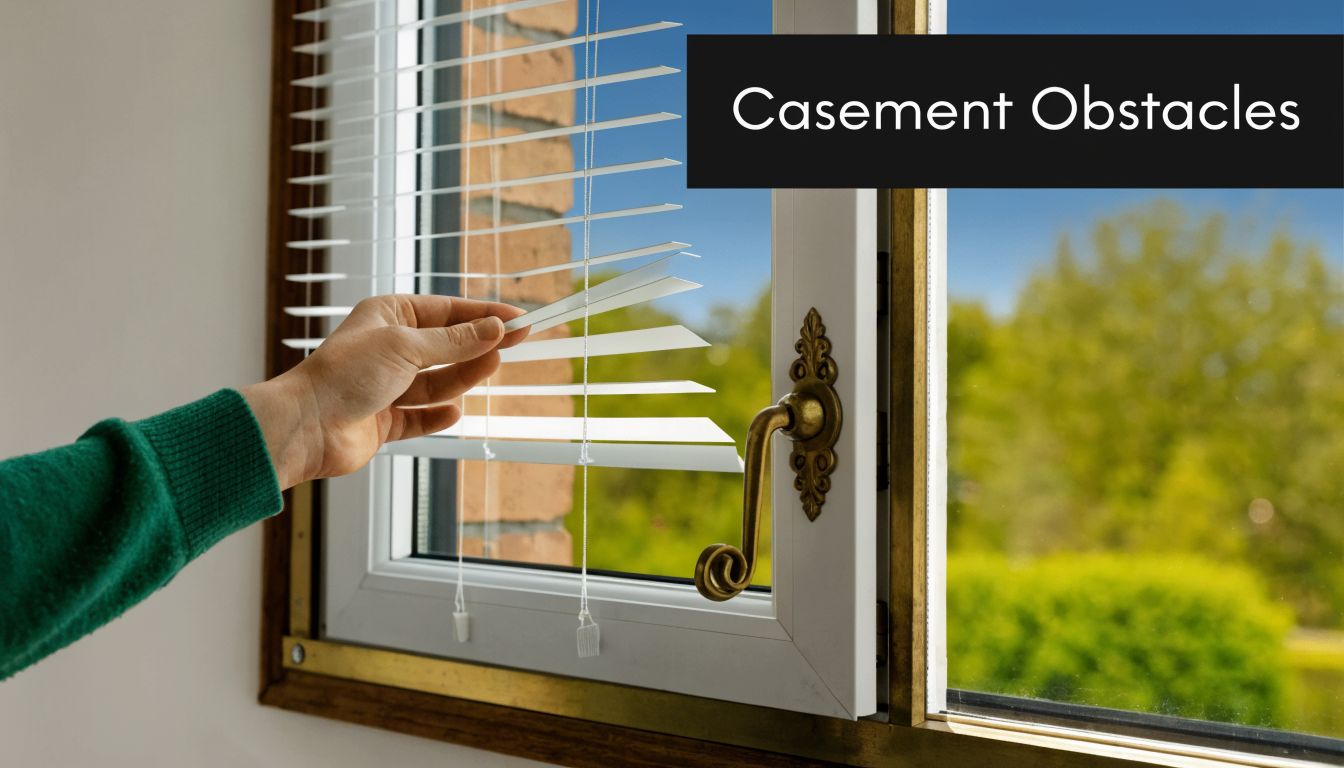
Casement windows usually create three trouble spots at once. The first is the crank handle. The second is the screen, which often sits inside. The third is depth, because the usable mounting space can be very limited.
If you want a good overview of how casement windows are built and why they behave differently from other window styles, Professional Window Cleaning's casement guide is a helpful primer.
The crank is the first obstacle
The crank projects into the same area where many blinds or shade bottoms want to sit. If the headrail is bulky or the fabric hangs too close to the handle, operation becomes annoying fast.
That’s why some products that look fine on paper fail in real rooms. You can install them, but you can’t comfortably use them.
The screen changes the available depth
Interior screens steal room that people often assume they have. A window may look deep enough for an inside mount until you account for the screen frame and hardware.
That’s where store-bought assumptions go wrong. The frame opening isn’t the same as the usable mounting depth.
Shallow frames limit your options
Casement windows often have minimal inside depth, especially once hinge arms and hardware are factored in. Some slim-profile shades can still work, but many traditional blinds need more space than the window offers.
Here’s the practical checklist I’d use in a home with casements:
- Check handle projection: Measure from the surface where the treatment will sit to the farthest point of the crank.
- Account for the screen: Don’t assume the screen can be ignored. It affects both fit and function.
- Look at headrail bulk: A blind with a deep headrail may be the wrong choice even if the width and height are correct.
- Test opening clearance: The window should still open and close without rubbing, catching, or forcing the treatment.
If a casement treatment only works when you’re careful every single time, it doesn’t really work.
Best Blinds and Shades for Casement Windows
The right product depends on whether you need slim clearance, better insulation, softer style, or stronger light control. On casement windows, function has to lead the decision. The window hardware decides more than the décor board does.
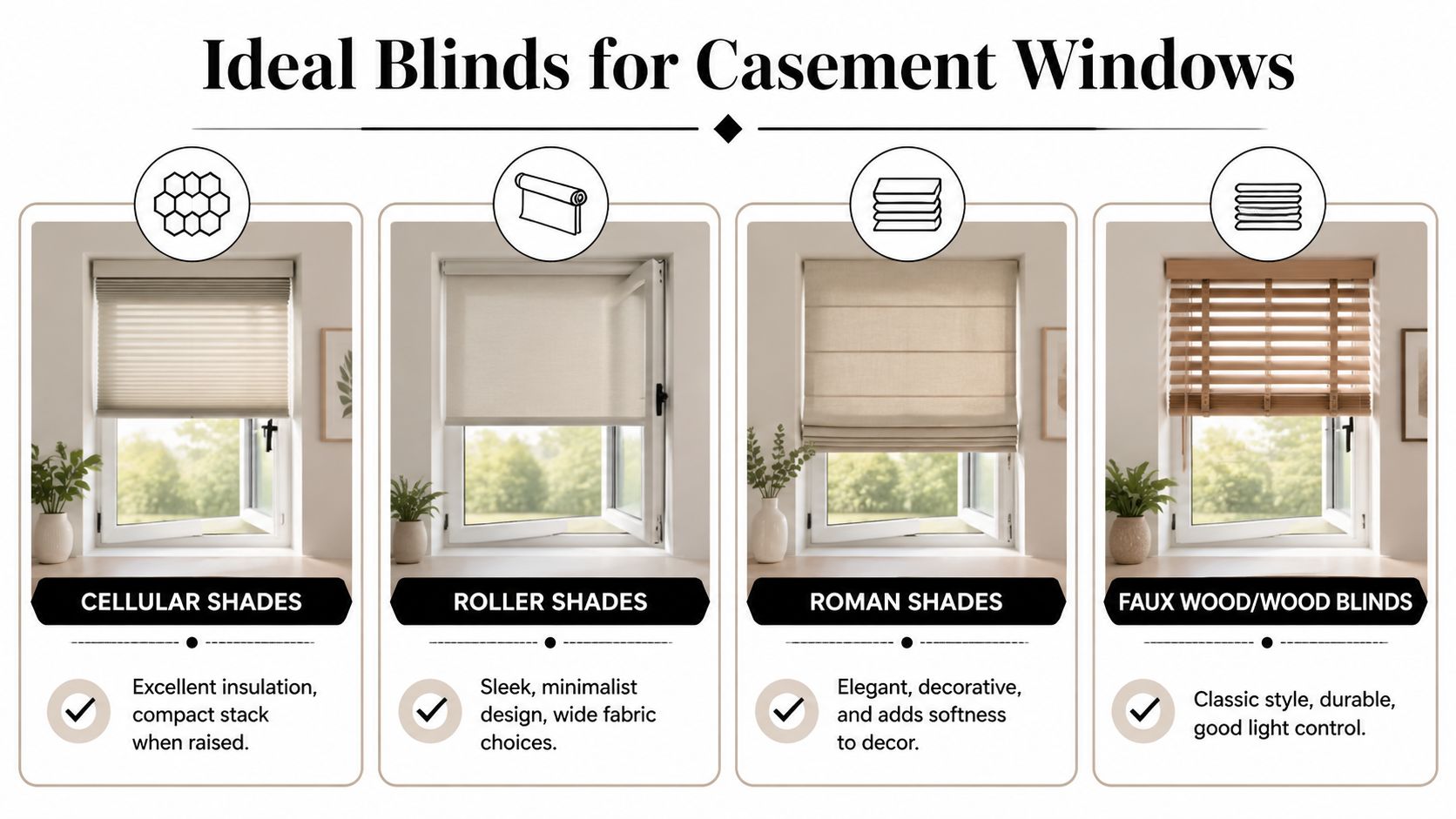
Cellular shades
Cellular shades are one of the safest bets for casement windows because the profile is compact and the stack is usually tidy. They’re especially useful when you want an inside-mount look without a lot of hardware crowding the frame.
They also stand out for performance. On casement windows, cellular shades can reduce heat gain by up to 45% and sound by 5 to 10 dB, while standard mini blinds offer 25 to 30% heat reduction, according to Graber’s angled window treatment guidance.
Best fit for:
- Bedrooms: Good insulation and privacy
- Living rooms: Clean appearance without visual bulk
- Windows with tight depth: Better odds of workable inside clearance
Trade-off: some fabrics and larger stacks can still interfere with hardware if measurements are too tight.
Roller shades
Roller shades are a strong choice when homeowners want a simple, low-profile treatment. They look clean, they don’t fight the architecture, and they’re easier to fit around a crank than many slatted blinds.
I like them most when the room needs a crisp look and easy maintenance. In a kitchen, office, or bath, that simplicity matters.
They also pair well with motorization. If you're exploring connected options, this overview of professionally installed smart shades gives a useful look at how automated systems fit into modern homes.
Trade-off: roller shades don’t give the same adjustable slat control that blinds do. You’re choosing fabric management, not slat tilting.
Roman shades
Roman shades can work beautifully on casement windows, but they require more caution. They add softness and depth, which many homeowners want in dining rooms, sitting rooms, and front-facing spaces.
The issue is bulk. When raised, Roman shades stack. On a casement, that stack has to stay clear of both the hardware and the practical sightline of the window.
They’re a better fit when:
- You’re using an outside mount
- The window trim gives enough placement freedom
- Style matters as much as pure clearance
Trade-off: if the window is tight or heavily used, Romans can feel less forgiving than a slimmer shade.
Faux wood and wood blinds
Many people favor these options due to their classic appearance and the ability to tilt slats for light control. Faux wood and wood blinds can work on casement windows, but they often need more planning than shades.
Their headrails are usually bulkier. Their slats also take up space when raised. On some casements, that means an inside mount won’t behave well even if it technically fits.
If you're weighing the pros and cons between slatted products and fabric options, this guide on the difference between blinds and shades helps clarify which direction makes more sense for your room.
These blinds make the most sense when:
- You want directional light control
- You’re comfortable with an outside mount if needed
- The room benefits from a durable, wipeable surface
Trade-off: they can be less forgiving around cranks and shallow frames than cellular or roller shades.
Plantation shutters
Plantation shutters aren’t the cheapest path, but they’re one of the most custom-fit solutions for casement windows when built and installed correctly. They suit the architecture well and give excellent control over privacy and light.
The catch is precision. Shutters have to be measured and configured around the window’s operation. If the frame, panel swing, or hardware accommodation is off, the whole result feels wrong.
Practical rule: On casement windows, the more rigid the product, the less room there is for measuring mistakes.
Shutters are best for homeowners who want permanence, structure, and a finished custom look. They’re not usually the right answer for every budget, but they often are the right answer for the window.
Casement Window Treatment Comparison
| Treatment Type | Best For Crank Clearance | Energy Efficiency | Mounting Flexibility | Best Use Case |
|---|---|---|---|---|
| Cellular Shades | Excellent with slim profiles | Strong | Good for inside or outside mount depending on depth | Bedrooms, living rooms, energy-conscious spaces |
| Roller Shades | Very good | Good qualitatively | Very flexible | Kitchens, bathrooms, modern interiors |
| Roman Shades | Fair to good, depends on stack | Moderate qualitatively | Better with outside mount | Decorative rooms where softness matters |
| Faux Wood or Wood Blinds | Good if properly spaced | Moderate qualitatively | Often better outside mounted on tight casements | Traditional interiors needing slat control |
| Plantation Shutters | Good when custom built around hardware | Strong qualitatively | Custom dependent | High-finish spaces and architectural windows |
Mounting and Measuring for a Flawless Fit
The mount choice controls whether the window will feel easy to use or irritating every day. On casement windows, that decision is rarely cosmetic alone.
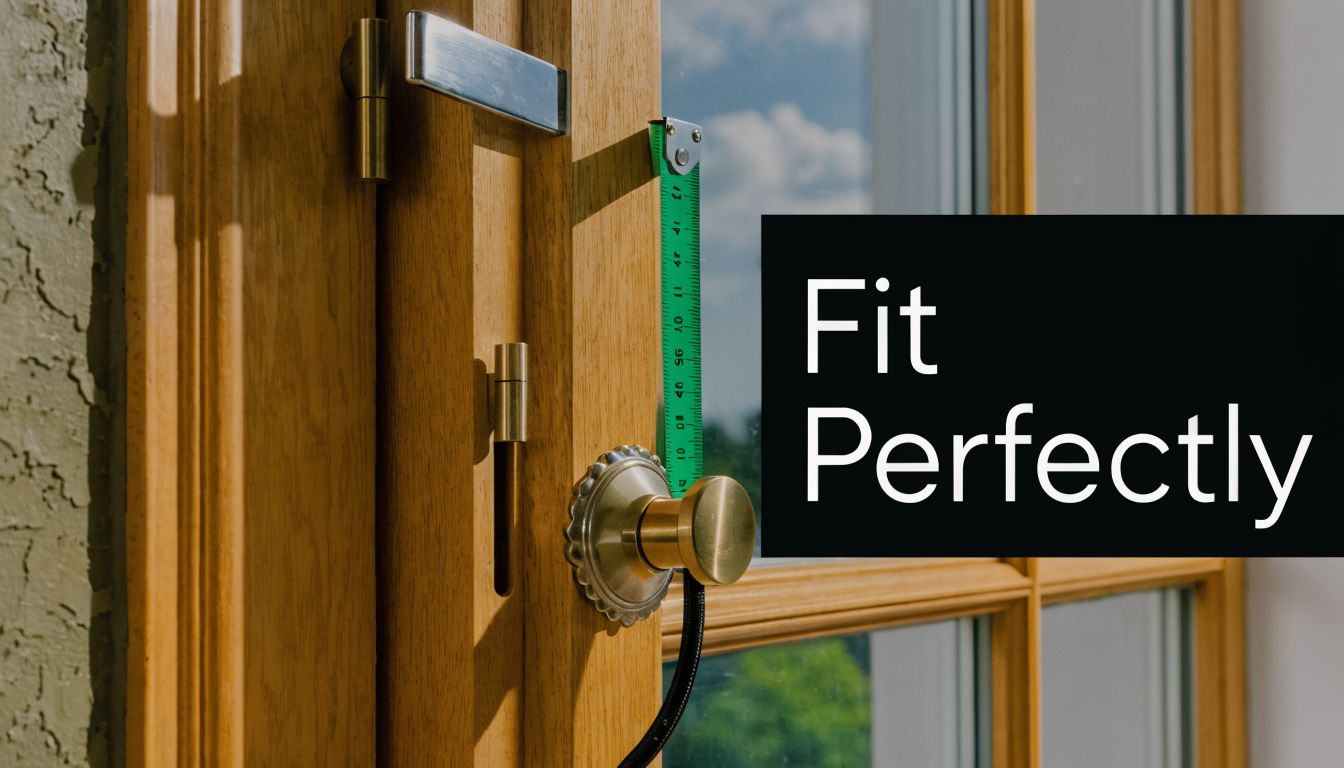
For casement windows with minimal depth, outside mounting is the primary recommendation, and spacer blocks can extend the headrail projection by up to 2 inches to create the room needed for crank rotation without interference, according to Blinds.com’s casement window covering guide.
Inside mount versus outside mount
An inside mount gives a neat, built-in appearance. It works best when the window has enough clear depth and the hardware doesn’t intrude into the product’s path.
An outside mount sits on the trim or wall area beyond the frame. On casement windows, that extra projection often solves the problem by moving the treatment away from the crank and screen.
Here’s the simple difference:
- Inside mount: Cleaner look, less forgiving
- Outside mount: More clearance, more practical on difficult casements
Why spacer blocks matter
Spacer blocks are one of those details homeowners rarely hear about until they’re needed. They move the headrail outward so the blind or shade clears the crank instead of colliding with it.
That’s not a minor adjustment. It can be the difference between a blind that operates smoothly and one that scrapes, binds, or forces the user to work around it.
A casement blind should never require a workaround to open the window.
Measurement matters just as much as hardware choice. A small error can leave an inside mount too tight, make an outside mount look off-center, or create uneven light gaps.
For homeowners who want to understand how to record room and opening dimensions more accurately before a consultation, these floor plan measurement tips are a useful reference.
If you want a more direct window-treatment-specific guide, this article on how to measure windows for blinds breaks down the process in plain terms.
A short walkthrough helps make the measuring logic easier to follow:
What to measure before choosing a product
Don’t stop at width and height. On a casement, these additional checks matter just as much:
- Depth to the screen or hardware
- Handle projection from the mounting surface
- Trim width for outside-mount brackets
- Obstructions near the swing path
People usually regret the order they placed too quickly, not the time they spent measuring carefully.
Choosing the Right Operation and Materials
The lift system and material finish matter more on casement windows than people expect. Good looks aren’t enough if the treatment is awkward to raise, catches on the handle, or doesn’t hold up in a humid room.
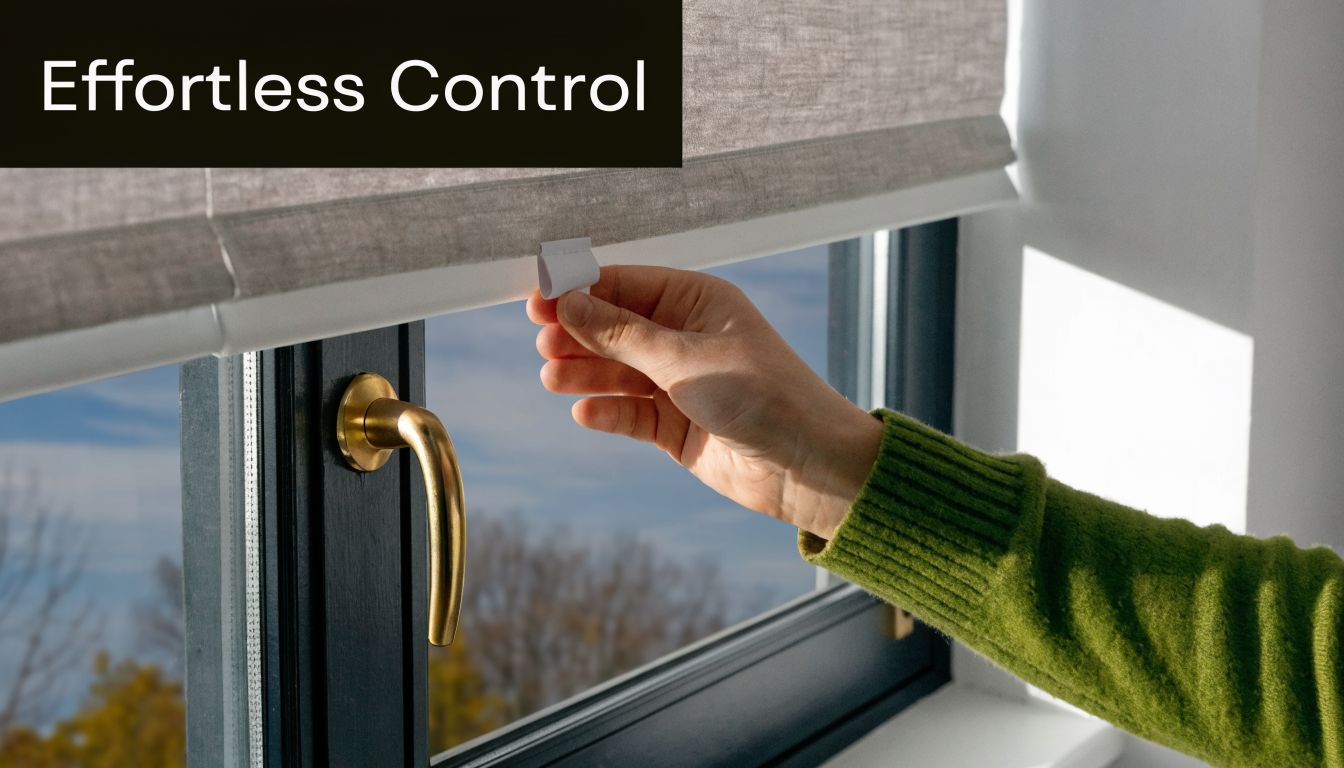
External blind cords are a real safety issue, with approximately 700 child injuries annually, and proper blind use can cut summer heat gain by up to 45%, based on this review of built-in blinds and Department of Energy guidance.
Cordless and motorized operation
Cordless isn’t just cleaner-looking. On a casement window, it removes one more thing that can tangle near the crank area or hang where it’s inconvenient to reach.
Motorized shades also make practical sense on windows that sit over tubs, behind furniture, or in hard-to-reach spots. If a window is awkward to access, a better lift system changes how often the treatment gets used.
That matters because the best product in the room still fails if nobody wants to operate it.
Materials that work better in West Tennessee homes
In kitchens, baths, laundry rooms, and other moisture-prone spaces, faux wood usually makes more sense than real wood. It gives the slatted look people want without the same concern over damp conditions.
For bedrooms and rooms that heat up in the afternoon, blackout or room-darkening cellular fabrics are often the stronger choice. They do more than darken the room. They help the window perform better and make the space feel more stable through the day.
A practical room-by-room approach works best:
- Bathrooms and kitchens: Faux wood blinds or easy-clean roller shades
- Bedrooms: Cellular shades for privacy and comfort
- Living spaces: Roller shades, Romans, or shutters depending on style
- High-use family areas: Durable finishes over delicate fabrics
Choose the operation system based on how you use the window, not how the sample looks on a display board.
Why Custom Installation Is Your Best Investment
Casement windows expose every weak decision. Wrong depth, wrong projection, wrong stack, wrong bracket location. Any one of those can make a treatment feel improvised.
That’s why custom installation isn’t just about appearance. It’s about getting all the moving parts to work together so the window still opens, the treatment still operates well, and the finished result looks intentional.
Off-the-shelf works until it doesn’t
A big-box blind may fit the width and height on the box. That doesn’t mean it accounts for the crank, screen, trim profile, or the amount of stack the product creates when raised.
Specialty casements make this even more obvious. For angled or sloped extensions, custom systems often need top- or bottom-compressing mechanisms, and stack height can increase by 2 to 3 inches, which is why expert measuring is so important, according to BCC Specialties product specifications.
Custom solves problems before they show up
The biggest advantage of custom work is that it addresses the hidden issues before ordering. Product depth, bracket placement, spacer needs, fabric stack, hardware clearance, and room conditions all get considered together.
That’s especially important for:
- Oversized casement units
- Grouped windows beside picture windows
- Angled or unusual openings
- Rooms where durability matters as much as style
If you want to see what that process looks like in practice, this page on custom blinds installation near me gives a good overview of why fit and installation quality matter so much.
Custom is the best investment when the window itself is asking for precision. Casements almost always are.
Transform Your Windows with Confidence
Blinds for casement windows aren’t hard because the choices are bad. They’re hard because the window has real physical limits, and the treatment has to respect them. Once you start with crank clearance, screen placement, mounting depth, and daily use, the right option becomes much easier to spot.
For some homes, that means cellular shades. For others, it means roller shades, faux wood blinds, shutters, or a carefully planned outside mount. The best answer is the one that lets the window work naturally while still giving you the privacy, light control, and style you want.
If you’d like help getting the measurements, mount, and product right the first time, call (731) 571-5179 for a custom install consultation. A professional fit saves time, avoids ordering mistakes, and gives you the confidence that the finished result will look and operate the way it should. The goal is simple. A smooth process, a clean installation, and 100% satisfaction.
For homeowners across West Tennessee who want blinds for casement windows done right, Blinds Galore offers custom install service, product guidance for difficult window types, and a commitment to 100% satisfaction. Call (731) 571-5179 to schedule your consultation and get a solution that fits your windows, your home, and the way you use the room.
You might also like

Best Plantation Shutter Brands – 2026 Review
If you're looking at your windows right now and thinking the room needs more polish, better privacy,

What Are Plantation Shutters Made Of
You're probably looking at a window right now thinking the same thing a lot of West Tennessee homeowners
Contemporary Roman Shades: Modern Styles for Your Home
You know the feeling. Your old blinds work, but they don't do your room any favors. They look hard,

Sliding Glass Window Treatments for Your West TN Home
That sliding glass door probably does two jobs at once in your home. It opens your living space to the
Vertical Blinds vs Horizontal Blinds: The Definitive Homeowner’s Guide
When you're trying to decide between vertical and horizontal blinds, it really comes down to your
Cordless Blinds vs Corded Blinds A Modern Homeowner’s Guide
When you're weighing the pros and cons of cordless blinds vs corded blinds, the verdict for today's