

Discover Perfect Window Treatments For Homes
If you're standing in your living room right now thinking, "This room gets too hot in the afternoon," or "I need privacy without making the house feel dark," you're not alone. A lot of West Tennessee homeowners start looking at window treatments for homes after getting tired of the same daily annoyances. Glare on the TV, fading furniture, bare windows that feel unfinished, or old blinds that never quite hang right.
Many quickly discover that window treatments aren't just about covering glass. They affect how a room feels. They soften hard lines, control sunlight, add privacy, and help a house feel pulled together instead of half-finished. In a place like West Tennessee, where humidity, bright sun, and changing seasons all play a part, the right choice matters more than people expect.
The good news is that this doesn't have to feel complicated. You don't need to memorize every product name or sort through endless samples on your own. You just need to understand what each option does well, where it works best, and what fits your home and your routine. That's where a local, custom install approach makes the process a whole lot easier, especially when you're aiming for a clean fit and 100% satisfaction.
Transforming Your Home with the Right Window Treatments
A common story goes like this. A homeowner updates the paint, replaces the sofa, adds a rug, and still feels like the room is missing something. Then the afternoon sun hits, the glare takes over, and the windows suddenly become the problem everybody notices.
That's why window treatments for homes do so much heavy lifting. They aren't an afterthought. They're part comfort, part function, and part design. A soft shade can calm a bright room. A shutter can make a front window feel polished from inside and out. Even a simple blind can clean up a space that feels visually busy.
Why more homeowners are paying attention
Homeowners are putting more thought into these decisions during remodels and room updates. The global window covering market was valued at USD 14.39 billion in 2024, with North America holding a 37.46% market share in 2025, driven largely by residential demand for products that improve aesthetics, energy efficiency, and privacy, according to window covering market research from Straits Research.
That makes sense on the ground here in West Tennessee. People want rooms that look better, feel cooler, and work harder every day. They also want something that fits the house instead of looking like it came off a shelf with a "close enough" measurement.
Practical rule: If a room feels unfinished even after you've updated furniture and paint, the windows are often the missing piece.
Small changes can shift the whole room
Think about a living room with wide front windows. Bare glass can make the room feel exposed. Heavy old curtains can make it feel dated. But a cleaner treatment, chosen for the way you use the space, changes the balance.
You can also tie window choices into the rest of the room. If you're working on a full refresh, this guide to living room wall art decor is a helpful example of how wall finishes, artwork, and window treatments can support each other without fighting for attention.
In practical terms, good window treatments help with:
- Comfort: Less glare and better control over direct sun.
- Privacy: You can keep a room open-feeling without feeling on display.
- Style: Windows stop looking empty or overlooked.
- Daily use: Raising, lowering, tilting, and cleaning become easier when the product fits.
A house starts feeling more like home when the windows finally work the way they should.
Understanding Your Options Blinds Shades and Shutters
Most confusion starts here because people use these words interchangeably. They aren't the same thing.
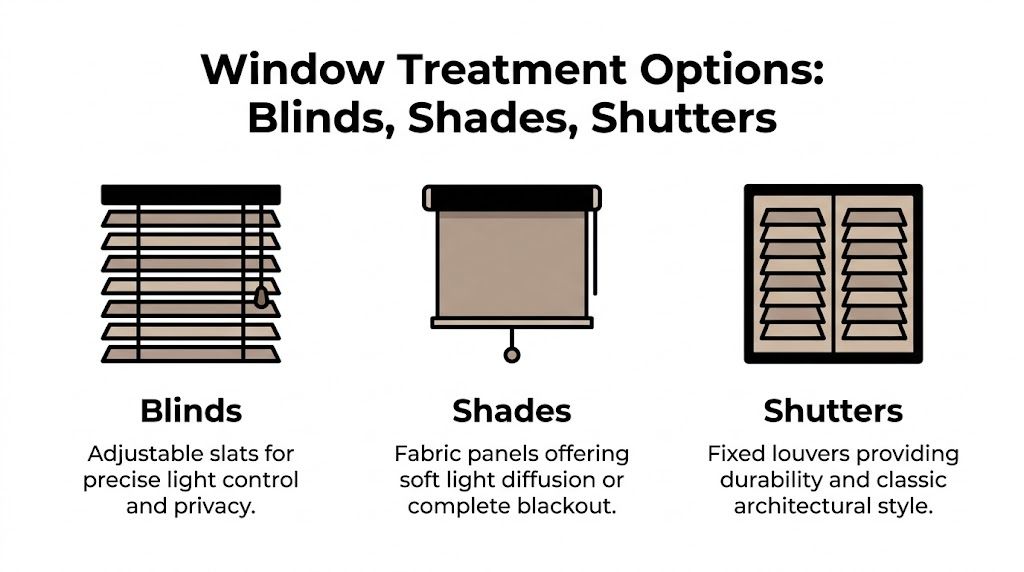
The easiest way to think about it is this. Blinds have slats. Shades are made from a continuous material. Shutters are fixed, structured window treatments that become part of the window itself. Once you understand that, the rest gets much easier.
What blinds do best
Blinds are the option many people know first. They use horizontal or vertical slats that you can tilt open, close, or raise. Wood blinds and faux wood blinds are common choices in homes because they give you flexible light control without a bulky look.
They're often a practical fit when you want to adjust sunlight throughout the day. If a room gets bright in the morning but you still want some view outside, blinds are helpful because you can angle the slats instead of fully opening or fully closing the treatment.
Cleaning matters too. If you already have slatted products in your home, this guide on the best way to wash blinds gives a straightforward look at routine care.
What shades do best
Shades don't have slats. They move as one piece of fabric or material. That gives them a softer appearance than blinds, which is why a lot of homeowners use them when they want the room to feel less busy.
Roller shades are simple and clean. Roman shades feel more decorative. Cellular shades add insulation and a more functional edge. If you've ever wondered why shades feel calmer visually, it's because the eye sees one continuous surface instead of many separate lines.
If you want a simple breakdown of product differences, this article on the difference between blinds and shades is useful before you make a final choice.
What shutters do best
Shutters are more architectural. They look built-in because they are custom-fitted to the window opening. Plantation shutters are especially popular because they work with many home styles, from traditional homes in older neighborhoods to newer builds that need a finished look.
They also stand out for durability. Plantation shutters offer exceptional durability, with materials like hardwood or composites that resist warping and fading. Their custom-fitted design and solid construction provide a lifespan of 25+ years, significantly outperforming blinds which typically last 5-10 years, and they can increase property value by 10-15% due to improved aesthetics and efficiency, according to Hunter Douglas's window treatment style guide.
Shutters usually feel less like an accessory and more like part of the house itself.
Window Treatment Comparison
| Feature | Blinds | Shades | Shutters |
|---|---|---|---|
| Construction | Slats that tilt and lift | Continuous fabric or material panel | Solid framed panels with louvers |
| Light control | Very adjustable | Depends on fabric and opacity | Strong control through louver adjustment |
| Visual style | Crisp and practical | Soft, clean, or decorative | Structured and architectural |
| Privacy | Flexible | Can range from filtered to blackout | Strong privacy with a finished look |
| Durability | Varies by material | Depends on fabric and use | Long-term, solid construction |
| Best fit | Everyday rooms, kitchens, offices | Bedrooms, living rooms, modern interiors | Main living areas, front windows, whole-home upgrades |
| Feel in the room | Functional | Soft and streamlined | Permanent and polished |
A simple way to choose
If you're still stuck, use this shortcut:
- Choose blinds if you want adjustable slats and a practical, familiar option.
- Choose shades if you want softness, cleaner lines, or better room darkening.
- Choose shutters if you want a long-term built-in look with strong durability.
That simple framework gets most homeowners much closer to the right answer.
The Key Benefits of Custom Window Treatments
Off-the-shelf products can cover a window. A custom treatment is meant to solve a problem cleanly. That's a big difference, especially when the window is wide, tall, oddly shaped, or in a room that gets punishing afternoon sun.
Custom window treatments for homes usually earn their keep in four ways. They control light better, protect privacy, improve comfort, and finish the room in a way generic products rarely do.
Better light control for real life
Light control sounds simple until you live with the wrong product. Some rooms need soft daylight. Some need glare reduction. Some need near darkness for sleeping, shift work, or a media room.
Custom sizing helps because the treatment is designed for the actual window opening, not a close estimate. That usually means fewer side gaps, cleaner stacking, and more predictable results when you lower or tilt the treatment.
Privacy without making the house feel closed in
Privacy is another place where homeowners get frustrated. They don't want neighbors seeing in, but they also don't want every room to feel shut off and heavy.
A well-chosen treatment can give you that middle ground. Light-filtering shades soften visibility. Shutters let you angle light while guarding the view inside. Layered options can also help if you want a room to feel open during the day and more private at night.
A good treatment should solve the privacy problem without creating a daylight problem.
Real help with insulation
In West Tennessee, product choice quickly becomes critical. Bright sun, muggy summers, and cooler winter swings can all show up at the window first.
Cellular shades are the most energy-efficient window treatment available, capable of reducing heat loss through windows by up to 40% or more. Their honeycomb structure traps air, creating an insulating barrier that can lower home heating and cooling costs by about 20%, especially in climates with significant temperature swings, according to the U.S. Department of Energy's guide to energy-efficient window coverings.
If insulation is near the top of your list, this overview of best window coverings for insulation can help narrow your options.
A stronger finished look
Custom treatments also improve how a room looks. That's not fluff. Windows take up a lot of visual space, and when they look undersized, crooked, or disconnected from the rest of the room, people notice even if they can't explain why.
Here are a few style improvements custom options usually bring:
- Cleaner fit: Treatments sit correctly in or on the opening.
- Better scale: Wider windows and taller rooms look balanced.
- Material choice: You can match the room instead of settling for whatever's in stock.
- Consistency: Multiple windows in one room can look intentional instead of pieced together.
That last point matters more than people think. Consistency across a room is often what makes the whole house feel calmer and more finished.
How to Choose Treatments for Your Rooms and Windows
One of the easiest mistakes is trying to use the same type of treatment everywhere. Rooms don't all work the same, so the windows shouldn't all be treated the same either.
A front living room has different needs than a bathroom. A bedroom has different needs than a kitchen over the sink. Once you look at each space by function first, the choices get clearer.

Living rooms and family rooms
These rooms usually need balance. You want privacy, but you also want daylight. You want style, but you don't want the treatment taking over the room.
Shades work well here when you want a softer look. Blinds work if you need more frequent adjustment through the day. Shutters often make sense on front-facing windows where appearance matters both inside and outside.
Bedrooms, kitchens, and baths
Bedrooms usually need more control. If the morning sun wakes you up too early, room-darkening or blackout options are worth discussing. If the room just needs privacy and a softer look, a light-filtering shade may be enough.
Kitchens and bathrooms need tougher materials. Humidity, splashes, and daily messes can be hard on the wrong product. Faux wood blinds and composite shutters are often easier to live with in these spaces because they handle moisture better than products that are more delicate.
If your kitchen is the room driving your search, this article on best window treatments for kitchens gives practical examples by layout and use.
What to do with unusual windows
Many homeowners get stuck: Arches, triangles, gables, bays, bows, and angled windows don't play nicely with standard store sizes.
An estimated 20-30% of homes feature irregularly shaped windows, such as arches or triangles, for which standard treatments are not suitable. Custom solutions like honeycomb shades for angled windows or plantation shutters for arches are essential, but homeowners often lack guidance on cost and installation for these unique challenges, especially in humid climates like West Tennessee's, according to Proctor Drapery's guide to irregularly shaped windows.
That lines up with what homeowners see in older homes and custom builds around Jackson, Humboldt, and nearby communities. The product itself matters, but the measuring matters just as much.
Local advice: Odd-shaped windows are where custom measuring stops being a luxury and starts being the whole job.
A few practical pairings often make sense:
- Angled or triangular windows: Cellular shades can be a smart option when insulation matters.
- Arched windows: Plantation shutters often keep the shape visible while still giving structure.
- Bay windows: Separate fitted treatments usually work better than trying to force one solution across all sections.
- Bathroom specialty windows: Moisture-resistant materials are usually safer than decorative fabric-first options.
A short video can also help if you're trying to visualize how window treatment styles function in a real room setup.
The easiest decision framework
If you're choosing room by room, keep it simple:
- Start with the problem. Is it glare, privacy, heat, moisture, or style?
- Match the product to the room. Bedrooms and baths don't ask for the same thing.
- Respect the window shape. Specialty windows usually need custom planning.
- Think about daily use. If you raise it every morning and lower it every night, operation matters.
That's the kind of conversation people usually need in a real in-home consultation. Not pressure. Just clear fit-for-the-room guidance.
Understanding Budget, Installation, and Warranties
A budget conversation usually starts the same way in West Tennessee homes. You stand in the room, look at the windows, and ask a simple question. "What will hold up here, look right, and stay within reason?" That is the right question, because price is only one part of the decision.
What you are paying for usually comes down to five things. The material. The size of the window. How custom the fit needs to be. The operating system. The difficulty of the installation. Blinds are often the entry point for homeowners who want solid function at a lower price. Shades can sit in the middle, especially once fabric upgrades or blackout features are added. Shutters usually cost more because they are built to fit the opening and become part of the room in a more permanent way.
West Tennessee weather can affect value too. Rooms with strong afternoon sun may need better light control and UV protection. Bathrooms, laundry rooms, and kitchens may call for materials that handle humidity without warping or wearing out early. A lower upfront price does not always mean a lower long-term cost if the product is a poor match for the room.
What changes the price the most
A few details tend to move the number more than anything else:
- Window size: Bigger openings need more material and sometimes heavier-duty hardware.
- Mounting conditions: Frame depth, trim, and sill shape can change how the treatment has to be installed.
- Material choice: Faux wood, woven shades, blackout fabrics, and composite products all come with different price points.
- Operation: Cordless and motorized systems add convenience, and they can add cost.
- Window shape: Arches, angles, and other specialty shapes usually require more custom planning.
Specialty windows often surprise homeowners. The challenge is not always the product itself. The challenge is getting the fit, operation, and finished look right on a window that was never built for an off-the-shelf solution.
Why measuring and installation deserve real attention
Good measuring works like tailoring a suit. Close is not close enough.
A custom treatment that is off by even a small amount can rub the frame, hang unevenly, leave larger light gaps than expected, or stack awkwardly when raised. Those are the problems that make a new purchase feel disappointing fast. Professional measuring helps prevent that before the order is ever placed.
Blinds Galore offers free in-home consultation, professional measuring, ordering support, and custom installation for homeowners who want help from the first sample to the finished install. That kind of guided process is especially helpful in older West Tennessee homes, where trim, frame depth, and window sizes do not always match what you see in a big-box store.
Safety and warranty questions
Safety has changed the way many window treatments are built and sold. For homes with children or pets, cordless operation is often the first feature worth asking about. For tall foyer windows or hard-to-reach spots above a tub or stairwell, motorization can make daily use easier.
Warranties matter for a different reason. They show what support you can expect if a mechanism fails, a component wears out, or something needs service after installation. Ask clear questions. What parts are covered? How long does coverage last? Who handles the service call? Those answers tell you a lot about the actual value of the purchase.
The goal is not to buy the fanciest option. It is to choose a treatment that fits the room, fits the budget, and keeps working the way it should.
Your Local West Tennessee Window Treatment Expert
Working with a local specialist feels different from walking into a big-box store aisle and trying to guess your way through sample cards. The main difference isn't just product selection. It's that someone can look at your actual windows, hear what isn't working, and recommend a treatment that fits the room, the light, and the way you live.
That's especially useful in West Tennessee homes. Some have older trim details. Some have newer open layouts with strong sun exposure. Some have moisture-prone bathrooms, tall entry windows, or room additions where store sizes don't line up well. A local expert sees those patterns all the time.
Why local service changes the experience
The process is simpler when you can ask practical questions and get practical answers.
- You can compare options in your own lighting. Samples often look different at home than they do under store lights.
- You can solve odd window issues early. That includes depth, trim, and unusual shapes.
- You get a clearer path to installation. Measuring and fit aren't left to guesswork.
- You know who to call if something needs attention. That matters long after the order is placed.
Service across the region
Homeowners and property owners across this part of the state often want the same thing. They want the job to feel easy, the fit to look right, and the result to last.
That includes people in Jackson, Dyersburg, Milan, Savannah, Paris, Medina, Lexington, Union City, Humboldt, and Huntingdon. Whether the project is one problem window or a full-house update, it helps to work with someone who understands the local climate, common home styles, and the value of custom install done carefully.
If you're ready to talk through options without pressure, call (731) 571-5179 and ask about a free in-home consultation. It's a simple starting point, especially if you want window treatments for homes that feel customized instead of improvised.
Frequently Asked Questions About Window Treatments
A lot of West Tennessee homeowners pause here for the same reason. They think they need to choose the product, color, mount style, and budget before they ever ask a question.
You do not.
A good window treatment project usually starts much simpler than that. It starts with one problem. Too much afternoon sun in the living room. A bathroom that stays damp. A bedroom that gets bright too early. Once you name the problem, the right options get easier to sort through.
How long does a window treatment project usually take
Most projects follow the same basic path. First, you talk through what the room needs. Then the windows are measured, the product is selected, the order is placed, and installation happens after the treatment comes in.
The timeline changes based on the product and the window itself. A standard shade for a simple window may move faster than shutters for older trim or a large specialty opening. Custom work asks for more patience, but it usually rewards you with a better fit, better light control, and fewer regrets later.
If you want the process to feel easier, make decisions in this order:
- Start with function. Privacy, glare control, room darkening, insulation, or moisture resistance.
- Choose the product type next. Blinds, shades, or shutters.
- Pick the style details last. Color, texture, and hardware finish.
That order keeps you from falling in love with a look that does not solve the problem.
Are motorized treatments worth it
For some windows, yes.
Motorization makes the most sense when a treatment will be used every day or when the window is hard to reach. Tall foyer windows, wide living room windows, media rooms, and bedrooms are common examples. In homes that get strong afternoon sun, scheduled shade movement can also help manage glare and heat before the room gets uncomfortable.
A simple way to judge it is to ask:
- Will this treatment go up and down often?
- Will manual operation be inconvenient enough that I may stop adjusting it?
If the answer is yes to both, motorization usually earns its place. If the window is easy to reach and you rarely change the position, a cordless manual option may do the job just fine.
What's easiest to maintain
The easiest product to maintain depends on where it will live.
Blinds collect dust on each slat, so they often need more frequent touch-up cleaning. Shades usually have fewer surfaces to dust, but fabric styles need gentler handling. Shutters are often easy to wipe down and tend to keep their shape well, which many homeowners like in busy rooms.
Rooms matter just as much as products. A kitchen window deals with grease in the air. A bathroom or laundry room deals with humidity. In West Tennessee, that moisture can hang around, especially in summer, so the material needs to match the room instead of just matching the paint color.
A few habits help any treatment last longer:
- Dust lightly and often.
- Clean kitchen treatments more regularly.
- Choose moisture-friendly materials for damp rooms.
- Operate the treatment evenly and gently.
A window treatment works a lot like a cabinet hinge. Use it the way it was designed, and it tends to last much longer.
Should every room in the house match
A coordinated look usually works better than an identical one.
Each room has a different job. Bedrooms often need privacy and darkness. Living rooms may need filtered light without closing the room off. Bathrooms need materials that handle moisture well. That is why one product across the entire house can feel forced, even if it looks simple on paper.
The better goal is visual consistency. You might repeat similar whites, wood tones, or clean lines while changing the product by room. That gives the house a connected look without asking one treatment to solve every problem.
Can you mix shutters, blinds, and shades in one home
Yes. Many homes look better that way.
For example, shutters may make sense on front-facing windows where you want a more permanent, finished look. Shades often work well in bedrooms and living spaces where softness and light control matter. Blinds can be a practical fit in utility areas, kitchens, or secondary rooms.
The mix works when the choices share a common thread. Similar color temperature, similar material tone, and simple hardware usually keep the whole house from feeling patched together.
What if I have tricky windows or older trim
That is often where custom work helps most.
Older homes rarely give you perfectly uniform openings. One window may be slightly out of square. Another may have shallow depth. A third may have trim that limits an inside mount. None of that is unusual, and none of it means you are out of options.
It just means the measuring and product choice need more care.
During a good consultation, these are the kinds of questions worth answering:
- Will an inside mount fit cleanly in this opening?
- Would an outside mount improve light control or appearance?
- Which materials make sense for this room's sunlight and moisture level?
- How much space will the treatment take up when open?
Those details are what help a finished install look intentional instead of improvised.
Do window treatments help homes feel more finished for resale
They often do.
Buyers notice windows quickly, even if they do not know the product names. A room with well-fitted treatments usually feels more settled and more complete. Front rooms, primary bedrooms, and main living spaces tend to make the strongest impression because those are the places where light, privacy, and overall appearance show up right away.
Even if a sale is years away, homeowners usually enjoy the benefit now. You get to live with the finished look instead of saving it for someone else.
Do you only work on homes, or can businesses get help too
Businesses can get help too.
Offices, clinics, storefronts, rentals, and other commercial spaces often need the same basic things a home needs. Privacy. Glare control. Easier light management. A cleaner finished appearance. The main difference is that commercial settings often place more weight on durability, uniform appearance, and simple operation.
The process is still straightforward. Look at the windows, identify the problem, choose the right product, and install it correctly.
What's the easiest first step if I'm overwhelmed
Start with one room that annoys you the most.
That might be the bedroom that gets too bright at sunrise. It might be the den that feels like a fishbowl after dark. It might be the kitchen window that has never had a treatment that really suited the space. Solving one room first gives you a reference point. After that, choices for the rest of the house usually come faster because you already know what matters most to you.
You might also like

Best Plantation Shutter Brands – 2026 Review
If you're looking at your windows right now and thinking the room needs more polish, better privacy,

What Are Plantation Shutters Made Of
You're probably looking at a window right now thinking the same thing a lot of West Tennessee homeowners
Contemporary Roman Shades: Modern Styles for Your Home
You know the feeling. Your old blinds work, but they don't do your room any favors. They look hard,
Sliding Glass Window Treatments for Your West TN Home
That sliding glass door probably does two jobs at once in your home. It opens your living space to the

Vertical Blinds vs Horizontal Blinds: The Definitive Homeowner’s Guide
When you're trying to decide between vertical and horizontal blinds, it really comes down to your
Cordless Blinds vs Corded Blinds A Modern Homeowner’s Guide
When you're weighing the pros and cons of cordless blinds vs corded blinds, the verdict for today's