

Vertical Blinds for a Bay Window: 2026 Guide
A bay window can be the prettiest spot in the house and the most aggravating one to cover. In West Tennessee, that usually shows up the same way. Morning sun pours into the breakfast nook, the front room feels exposed at night, and every off-the-shelf blind you try leaves awkward gaps or a chopped-up look.
That’s why so many homeowners start out wanting something simple and end up frustrated. Bay windows aren’t standard openings. They bend, project, and change angle from section to section. The treatment has to do more than fit the glass. It has to operate cleanly, look intentional, and hold up to daily use.
Vertical blinds for a bay window are still one of the most practical answers when they’re designed and installed correctly. The key is not the word “vertical.” It’s the custom track, the measuring, and the way the whole system is built around the actual shape of your window.
The Beauty and Challenge of Bay Windows
Bay windows earn their keep every day. They pull in light, open up a room, and give a home more character from both inside and out. Around Jackson, Dyersburg, and the surrounding towns, they’re common in living rooms, dining rooms, and front sitting areas where homeowners want that wider view.
They also create the same complaints over and over. Too much glare in the afternoon. Not enough privacy after dark. Furniture getting blasted by sun. A patchwork of mismatched blinds that never looks finished.
That struggle isn’t new. Vertical blinds became popular during the post-war housing boom, when bay windows surged in U.S. suburban homes by 40%, and their design suited the non-standard angles found in 70% of bay configurations, according to this vertical blinds buying guide. That history matters because the basic problem hasn’t changed. Bay windows still need a treatment that can handle wide glass and unusual angles without fighting the architecture.
A lot of homeowners love specialty windows in theory but get stuck when it’s time to cover them. That happens with bays, and it happens with other projection-style windows too. If you’re comparing layouts, this look at garden windows helps show how decorative window styles can add charm while also creating their own practical design demands.
Bay windows need a treatment that respects the shape instead of trying to force it into a standard rectangle.
What homeowners usually want
Those calling about a bay window are often trying to solve several problems at once:
- Better light control so the room isn’t washed out at certain times of day
- Real privacy without closing off the whole space
- A cleaner look than three separate blinds fighting each other
- Easy operation that doesn’t catch, drag, or hang unevenly
Vertical blinds can answer all four. They stack neatly, work well across broad glass areas, and can be made to follow the actual line of the bay instead of breaking it into disconnected pieces.
Why Bay Windows Defy Standard Blinds
The trouble starts when homeowners assume every bay window is basically the same. It isn’t. Some are squared off. Some angle outward in straight sections. Some sweep in a gentle curve. The shape decides what hardware can work and where the weak spots will show up.
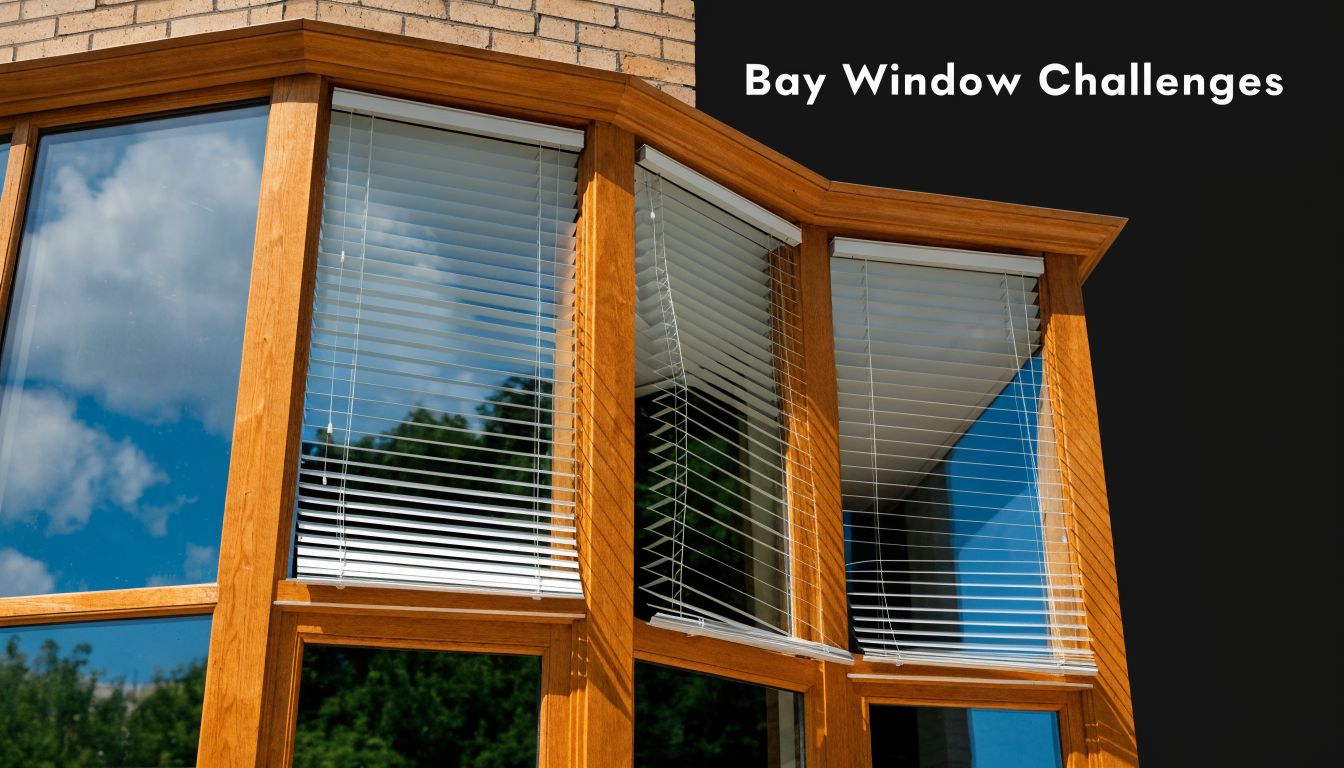
The three bay window layouts that change everything
Canted bays are the most familiar in older homes and many traditional neighborhoods. They usually have a center window with angled side sections. These are the windows that look straightforward until you realize each return creates a joint where light can sneak through.
Box bays project outward with sharper corners. They can be great for seating or display space, but they’re less forgiving when you try to mount standard blinds across multiple sections. Hardware clearance becomes a real issue fast.
Bow windows use more sections and create a softer curve. They look elegant, but that curve is exactly why rigid, separate blinds often feel pieced together instead of integrated.
A lot of shoppers start by comparing products made for big openings in general. That helps, but it doesn’t solve angle-specific problems. If you're sorting through broader options first, this guide to blinds for large windows is a useful starting point before narrowing down what works on a bay.
Where standard blinds fail
Off-the-shelf blinds usually fail in one of three ways.
First, they leave light gaps where one blind ends and the next begins. Second, they crowd the trim or window handles because the brackets weren’t designed for projecting sections. Third, they operate like three separate jobs instead of one finished system.
That’s why a bay can look fine from across the room and still be frustrating every single day.
Separate blinds may cover each pane, but they rarely solve the bay as a whole.
The sharp-corner problem most articles skip
Many guides gloss over the hardest installs. Bay windows with sharp 90-degree corners or narrow mullions under 2 inches are especially tricky. Standard installations can leave persistent light gaps, and fixing that takes specialized manufacturing and precise measuring, as noted in this guide on vertical blinds for bay windows with sharp corners.
That matters in West Tennessee because older homes often have exactly those tighter corners and narrower trim conditions. On paper, vertical blinds sound easy. In the field, those details decide whether the system looks custom or compromised.
Here’s a helpful visual if you want to see why angled openings create so many fit problems before the right hardware is selected:
Common trouble spots in older homes
Older bays tend to bring extra complications:
- Uneven trim profiles that change bracket placement
- Non-identical window sections even when they look symmetrical
- Tight return walls that limit stack space
- Settled framing that throws off simple tape-measure assumptions
Those are exactly the situations where a standard blind order goes sideways. The window may not be difficult because it’s large. It’s difficult because every angle affects the next one.
The Custom Track System That Makes It Work
The part that makes vertical blinds for a bay window succeed is the custom-curved headrail. That rail is the lock, and the bay shape is the key. If the rail doesn’t match the window, the rest of the system can’t fix it.
A proper bay setup uses a track that follows the geometry of the window instead of stopping and restarting at each section. That one decision changes the look and the operation. The vanes hang in sequence, rotate together, and stack in a way that feels planned rather than pieced together.
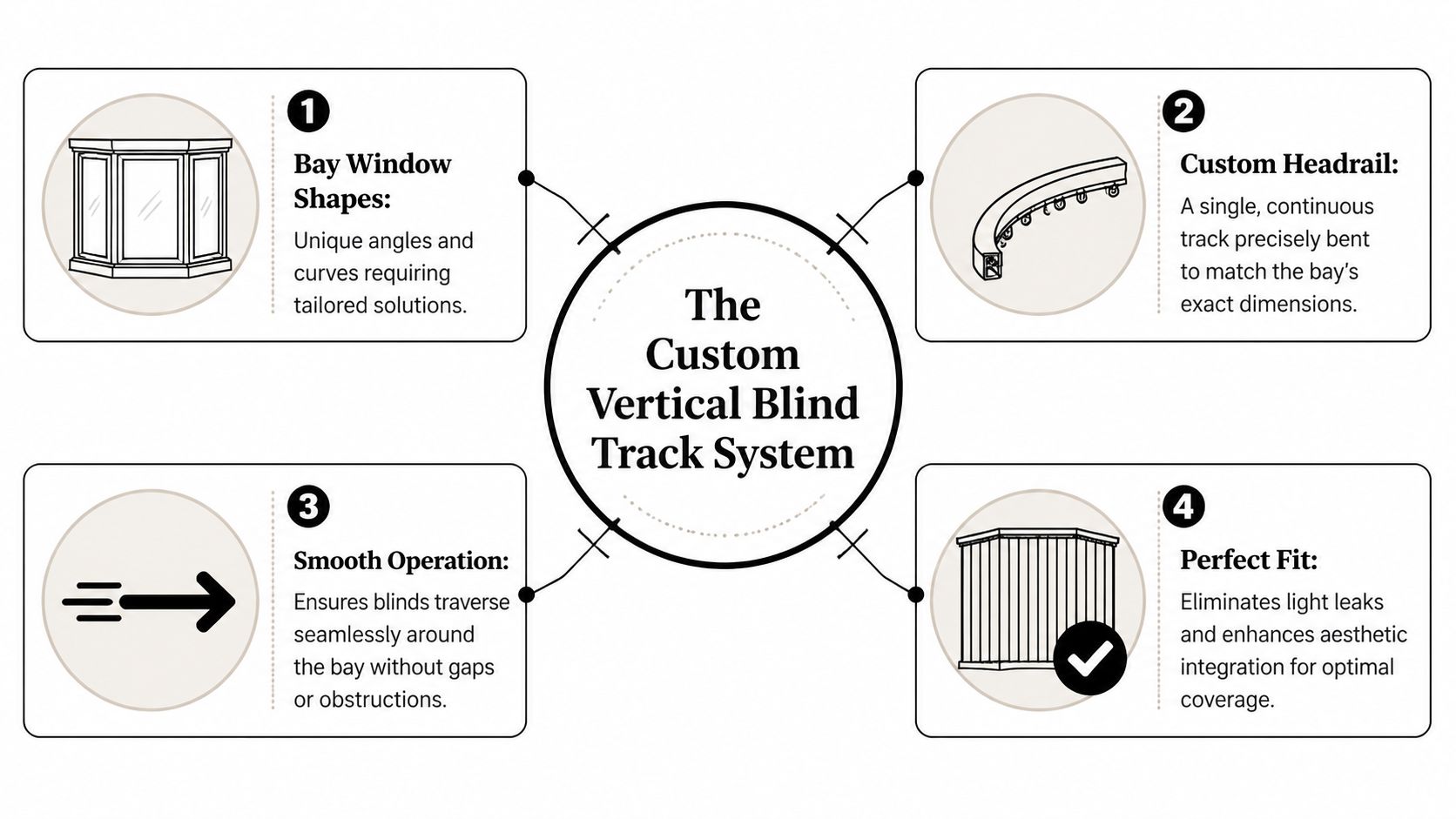
Why one shaped rail beats separate straight rails
A custom bay track is built to match the actual angles or curve of the opening. That’s why it handles both the visual line and the mechanical job better than multiple straight rails.
According to technical guidance on vertical blind dimensions and track design, bay systems use custom-curved aluminum headrails that follow the window’s geometry precisely. Those tracks can allow vanes to hang with as little as a 3/8” gap from the jamb, delivering up to 95% privacy and minimal light leakage when closed.
That’s the difference homeowners notice right away. The blind looks closer to the window, the joints read cleaner, and the room feels less exposed at night.
What’s happening inside the hardware
The hardware matters more than commonly understood. A quality vertical system for a bay uses a shaped aluminum rail, carriers that move smoothly through the path of the track, and control components built to keep the vanes evenly spaced as they rotate and traverse.
When that system is specified correctly, you get:
- Cleaner closure across angled sections
- More consistent vane spacing
- Less drag during operation
- A tidier stack when the blinds are open
When it’s specified poorly, the vanes bump, overlap strangely, or refuse to line up at the corners.
Practical rule: If the headrail design is treated like an afterthought, the bay window will never feel finished.
Stack direction is not a small decision
Homeowners often focus on color first. For a bay, stack direction deserves equal attention. The vanes can usually stack left, right, or split, depending on the room layout and the way you use the space.
Here’s how that choice affects daily use:
| Stack option | What it’s good for | What to watch for |
|---|---|---|
| Left stack | Keeps one side cleaner visually | Can crowd a side wall or trim return |
| Right stack | Works well when furniture blocks the opposite side | May interrupt the preferred view line |
| Split stack | Balanced look across the bay | Needs enough room on both sides for a neat stack |
A good installer looks at how you enter the room, where the sun hits, and whether you want the main viewing area opened from the center or cleared to one side.
Shape, vane style, and sightline
There’s another detail that affects appearance more than people expect. Flat vanes and S-curve vanes don’t read the same once they’re installed across a bay. Flat vanes feel crisp and traditional. S-curve vanes create a softer line and can feel a little more like drapery when closed.
The track has to be specified to match the vane style from the start. That isn’t a detail to sort out later. On a bay window, every component has to agree with the geometry.
Choosing Your Vanes Materials and Controls
Once the track is right, the next decision is how you want the blinds to live in the room. Here, function and style converge. The material changes the look, the amount of softness, how easy cleaning will be, and how the blind holds up in daily life.
PVC or fabric
For most homes, the choice comes down to PVC (vinyl) or fabric.
PVC works well when you want a cleaner-lined, more practical finish. It’s easier to wipe down, holds up well in busy households, and makes sense in rooms where fingerprints, dust, or kitchen residue are part of life. Fabric softens the bay visually. It diffuses light in a gentler way and often feels more at home in living rooms, sitting rooms, and bedrooms.
Here’s the side-by-side view.
Vertical Blind Material Comparison
| Feature | PVC (Vinyl) | Fabric |
|---|---|---|
| Overall look | Crisp, tailored, straightforward | Softer, warmer, more decorative |
| Cleaning | Wipes down easily | Usually needs gentler spot cleaning or light vacuuming |
| Best fit for busy spaces | Strong choice | Better where wear is lighter |
| Light feel | More defined light control | Softer filtered effect depending on fabric |
| Design style | Practical, clean-lined rooms | Living spaces where texture matters |
| Maintenance feel | Lower fuss | Slightly more care required |
What works in real rooms
In a front living room with a street-facing bay, fabric often wins on appearance. It takes the edge off the vertical lines and feels more finished when the room has upholstered furniture, rugs, and softer textures.
In a breakfast area or den, PVC usually makes more sense. It’s the easier product to live with if kids, pets, or regular mess are part of the picture.
A few practical observations help narrow it down:
- For low-maintenance households: PVC is usually the safer call.
- For a softer designer look: Fabric tends to blend better with layered interiors.
- For strong sun exposure: Material selection should match how much light you want to filter versus block and how you want the room to feel.
Flat vanes or S-curve vanes
This choice is mostly visual, but it changes the personality of the window.
Flat vanes give you the classic vertical blind look. They suit traditional, transitional, and simpler interiors.
S-curve vanes create a more flowing face when the blinds are closed. They can look less office-like and more decorative, especially on a prominent front bay.
Neither is automatically right. The better choice depends on the room, the trim style, and whether you want the bay to read crisp or soft.
If the bay window is the first thing you see when you enter the room, vane style deserves more attention than color alone.
Wand control or motorization
Manual wand control is still a solid option. It’s straightforward, dependable, and easy for most homeowners to use every day.
Motorization has become a much bigger part of the conversation. According to this report on motorized blinds for bay windows, motorized vertical blinds for bay windows have seen 35% year-over-year growth since 2025, driven by accessibility, convenience, and smart home integration.
That trend makes sense, especially when the bay is tall, wide, or partly blocked by furniture.
When manual control still makes sense
Manual control is often the better fit when:
- The bay is easy to reach
- You want the simplest mechanism
- You prefer a lower-complexity setup
- Only one person regularly uses the room
When motorization is worth a look
Motorized control is useful when:
- The bay spans a large front room
- The vanes are opened and closed often
- A homeowner wants easier access
- The window is part of a broader smart-home setup
One local option homeowners consider is Blinds Galore, which offers custom window-covering consultations in West Tennessee and can help compare manual and motorized vertical systems based on the window layout and room use.
Why Professional Installation Is Not Optional
Bay windows punish small mistakes. A regular window might forgive a bracket that’s slightly off or a width measurement that isn’t perfect. A bay won’t. One error at one angle affects clearance, vane alignment, stack position, and the amount of light that leaks through at the joints.
That’s why this is not a casual DIY project.
What goes wrong with do-it-yourself installs
Most DIY failures happen before the blinds ever arrive. The measurements were taken from the wrong point, the projection of the trim wasn’t accounted for, or the homeowner assumed all three sections were identical when they weren’t.
Then installation day creates the second wave of trouble:
- Brackets land in the wrong position
- The track interferes with trim or handles
- The vanes don’t clear the jamb cleanly
- The corners show more gap than expected
If you’ve ever looked at a house before buying and realized a professional eye can spot things others miss, the same logic applies here. There’s real value in understanding the need for a professional assessment before making a decision that affects cost, appearance, and long-term performance.
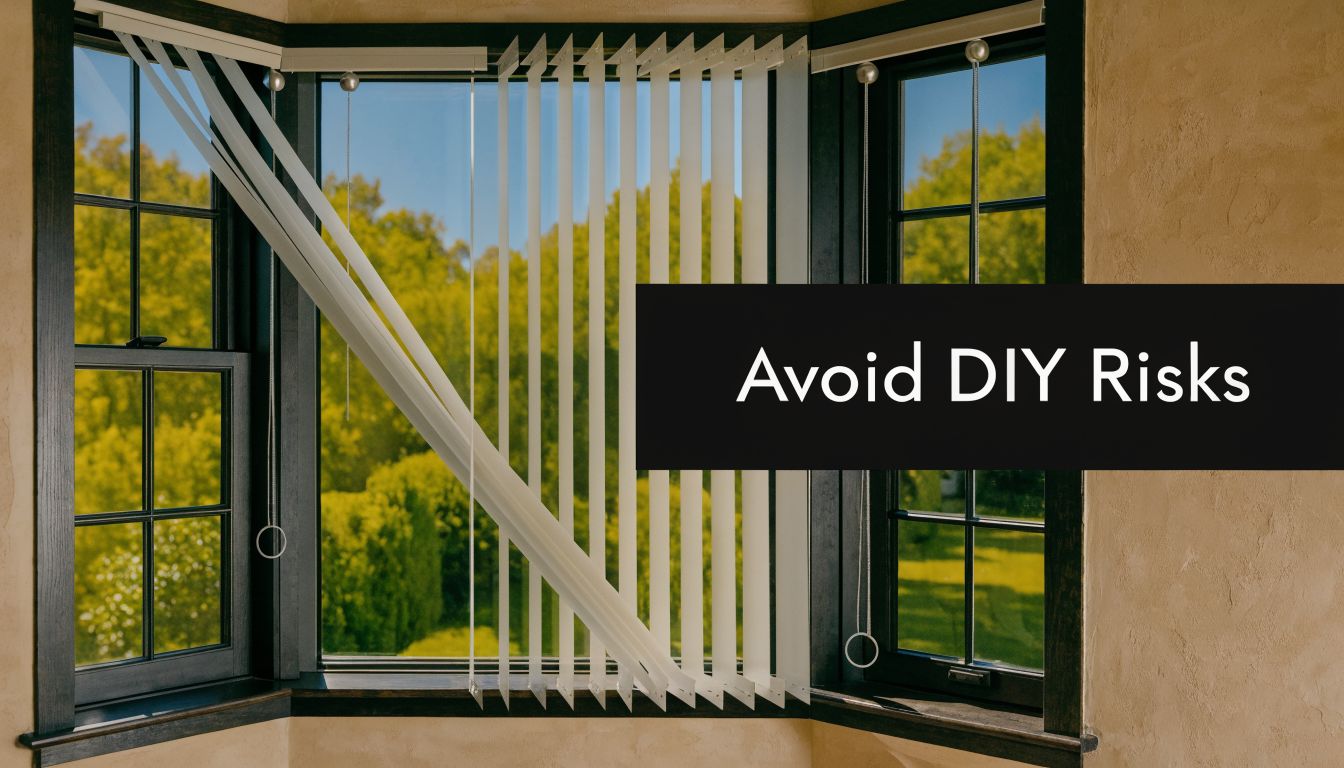
Why precision matters beyond appearance
A professional, custom installation does more than make the blinds look better. It affects comfort and efficiency too. This overview of energy-efficient vertical blinds for bay windows notes that by eliminating gaps, properly installed blinds can reduce heat loss in winter, block up to 99% of UV rays in summer, and potentially lower energy bills by 10% to 25% for homeowners in West Tennessee.
That only happens when the system is fit tightly enough to do its job. A custom blind with installation gaps gives away part of the benefit you paid for.
What a professional process should include
A solid process should never be just “measure, order, hang.” It should include:
- In-home evaluation with real sample materials and vane options
- Precise measuring of each section, angle, trim projection, and mounting condition
- Product matching based on room use, privacy needs, and stack preference
- Final installation that makes sure the system traverses and rotates correctly
If you want to see why homeowners often get tripped up on the first step alone, this guide on how to measure windows for blinds shows how quickly measuring becomes more technical than it looks.
For homeowners in this area, the practical route is simple. Get the bay evaluated in person, get it custom fit, and get it installed by someone who deals with angled windows regularly. If you want custom install backed by 100% satisfaction, call (731) 571-5179 before ordering anything.
Your Guide to Costs Care and Long-Term Value
Bay window treatments shouldn’t be judged on sticker price alone. The smarter question is what you get for the money over time. A bay is too visible and too functional to treat as a throwaway purchase.
Upfront cost versus long-term return
Vertical blinds compare well when homeowners are looking for a custom solution without stepping into the price range of plantation shutters. According to the same energy-efficiency reference noted earlier, vertical blinds can come in at 30% to 50% lower initial cost than plantation shutters, with listed pricing of $20 to $40 per square foot versus $50 to $100, while still offering comparable energy performance in many situations.
That makes them attractive for homeowners who want a custom-fit product with solid everyday function.
The long-term value improves because quality vertical blinds can last 10 to 20 years with daily use, and that same source notes they can outlast curtains by 5 to 10 years. On a prominent bay window, that matters. Replacing a failed or dated treatment is more expensive than getting the right one the first time.
Where the value really shows up
The return isn’t only about durability. It shows up in several places:
- Energy performance in a window area that often takes a lot of sun
- Protection for interiors when the blinds are closed during bright parts of the day
- Daily convenience from easier light and privacy control
- A more finished room that doesn’t need layers of workaround treatments
Easy care that extends the life of the blinds
Maintenance is simple if you stay consistent.
For PVC vanes, use a soft cloth or gentle vacuum attachment to remove dust and wipe spots before buildup hardens. For fabric vanes, use light vacuuming and careful spot cleaning based on the material. In either case, keep the track free of dust and avoid forcing the vanes if something catches.
A custom blind lasts longer when homeowners operate it gently and clean it lightly, instead of waiting until dirt and friction become a problem.
A bay window is a focal point. The treatment should be durable enough to earn that spot.
Your Perfect Bay Window Solution in West Tennessee
A bay window needs more than a nice-looking blind. It needs a system built for angles, stack space, privacy, and smooth everyday use. That’s why vertical blinds for a bay window work well when they’re custom fit and professionally installed, and why they disappoint when someone tries to force a standard product into a non-standard opening.
Homeowners around Jackson, Milan, Huntingdon, Paris, and nearby communities usually don’t need more online guesswork. They need someone to look at the actual window, check the corners, evaluate the trim, and recommend the right track, vane style, and control option for that room.
If you’re ready to stop fighting a difficult bay and start with a custom approach, take a look at custom blinds installation near me to see what a local installation process should look like.
Then make the easy move. Call (731) 571-5179 for a free, no-obligation in-home consultation and ask for a custom install with 100% satisfaction.
Frequently Asked Questions
FAQ Section
| Question | Answer |
|---|---|
| Can vertical blinds really work on a bay window? | Yes, if the system is built for the window’s shape. The key is a custom track and accurate measuring, especially when the bay has angles, curves, or tight corners. |
| Do bay windows always need one continuous track? | Not always. Some box-style bays can use separate sections, but a custom-shaped track usually creates a more unified look and better control across the full opening. |
| Are vertical blinds outdated for living rooms? | Not when they’re specified well. Modern vane styles, cleaner fabrics, and better track systems give them a more finished look than many homeowners expect. |
| What’s the biggest mistake people make when ordering them? | Assuming each section of the bay is identical and measuring too simply. Small differences in angle, trim depth, and projection can change the fit. |
| Do vertical blinds block too much of the view? | They can preserve a very open feel because the vanes stack to the side. The exact result depends on the stack direction and the shape of the bay. |
| What material is easier to live with, PVC or fabric? | PVC is usually easier to clean and suits busier spaces. Fabric gives a softer look and can feel more decorative in formal living areas or bedrooms. |
| Is motorization worth considering? | It can be, especially on larger or harder-to-reach bays. Homeowners who use the blinds often or want easier operation usually appreciate it more than occasional users do. |
| Can these help with privacy at night? | Yes. A properly fitted vertical system can offer strong privacy when closed, particularly when the track and vane spacing are specified for the bay correctly. |
| How long does the process usually take? | Timing varies by product and customization, so it’s better handled during an in-home consultation than guessed online. |
| Should I try to install bay window blinds myself? | For a standard window, maybe. For a bay, it’s risky. The cost of one measuring or bracket-placement mistake can outweigh any labor savings quickly. |
If your bay window is too bright, too exposed, or too awkward for store-bought blinds, Blinds Galore can help you sort out the right custom solution in plain English. Call (731) 571-5179 to schedule a free in-home consultation and get a custom install with 100% satisfaction.
You might also like

Best Plantation Shutter Brands – 2026 Review
If you're looking at your windows right now and thinking the room needs more polish, better privacy,

What Are Plantation Shutters Made Of
You're probably looking at a window right now thinking the same thing a lot of West Tennessee homeowners

Contemporary Roman Shades: Modern Styles for Your Home
You know the feeling. Your old blinds work, but they don't do your room any favors. They look hard,

Sliding Glass Window Treatments for Your West TN Home
That sliding glass door probably does two jobs at once in your home. It opens your living space to the
Vertical Blinds vs Horizontal Blinds: The Definitive Homeowner’s Guide
When you're trying to decide between vertical and horizontal blinds, it really comes down to your

Cordless Blinds vs Corded Blinds A Modern Homeowner’s Guide
When you're weighing the pros and cons of cordless blinds vs corded blinds, the verdict for today's