

How Much Do Shutters Cost Per Window? A 2026 Price Guide
Most homeowners will spend about $150 to $600+ per window for shutters, depending on the material, size, and how custom the build needs to be. For a full home, installed shutter projects commonly land in the $2,000 to $4,000 range, with a national average of around $2,400.
If you're standing in your living room in Jackson, Milan, or Humboldt looking at tired blinds and wondering whether shutters are worth the jump, you're asking the right question. Shutters aren't cheap. They are a custom product, and the final number depends on what you're putting on the window, how large the opening is, and whether the window is a clean standard rectangle or something that fights the installer.
The good news is that shutter pricing isn't mysterious once you know what drives it. Big-box stores tend to advertise the low end and leave out the parts that matter most, like fit, frame style, moisture resistance, and labor. That's where homeowners get blindsided.
This guide gives you the straight answer on how much do shutters cost per window, what changes the price in West Tennessee homes, and where it's smart to spend more versus where it isn't. If you'd rather skip the guesswork and talk through your windows with someone local, call (731) 571-5179 for a free in-home consultation with custom install and 100% satisfaction.
Your Guide to Understanding Shutter Costs in West Tennessee
A lot of people start the same way. They replace one broken blind, then notice the rest of the room looks dated. Next thing you know, they're pricing plantation shutters because they want something cleaner, sturdier, and better looking from both inside and outside the house.
In West Tennessee, that decision usually comes down to two things. First, you want the room to look finished. Second, you don't want to spend money twice on a product that can't handle humidity, daily use, or awkward older window openings.
That's why the price range is so wide. A simple vinyl shutter on a standard window doesn't cost the same as a hardwood shutter built for a larger living room opening. And a quote from a website isn't the same as a real number after someone measures your home.
Local reality: The word "custom" isn't code for overpriced. It usually means the shutter is built to your exact opening so it fits, swings correctly, and looks built-in instead of added-on.
For homeowners around Jackson and the surrounding area, the smartest move is to understand the baseline first, then compare that to your actual windows. If you want a broader local overview before diving into the per-window numbers, this West Tennessee shutter cost guide is a useful starting point.
A shutter quote should make sense when someone explains it. It should tell you what material you're getting, why that material fits your room, and what part of the price is tied to the window itself. If the quote feels vague, that's a red flag.
Shutter Costs Per Window A Quick Price Breakdown by Material
If you want a straight answer, start with the material. In West Tennessee, that choice usually matters more than brand names or showroom labels because material affects both the price you pay now and how the shutters hold up in humidity, sunlight, and everyday use.
At the national level, installed shutter projects often fall in the low-thousands for a full home, as noted earlier. For a single window, the useful way to price shutters is by material and by whether the quote is given per panel or per window. Big-box pricing often blurs that difference. A local quote should not.
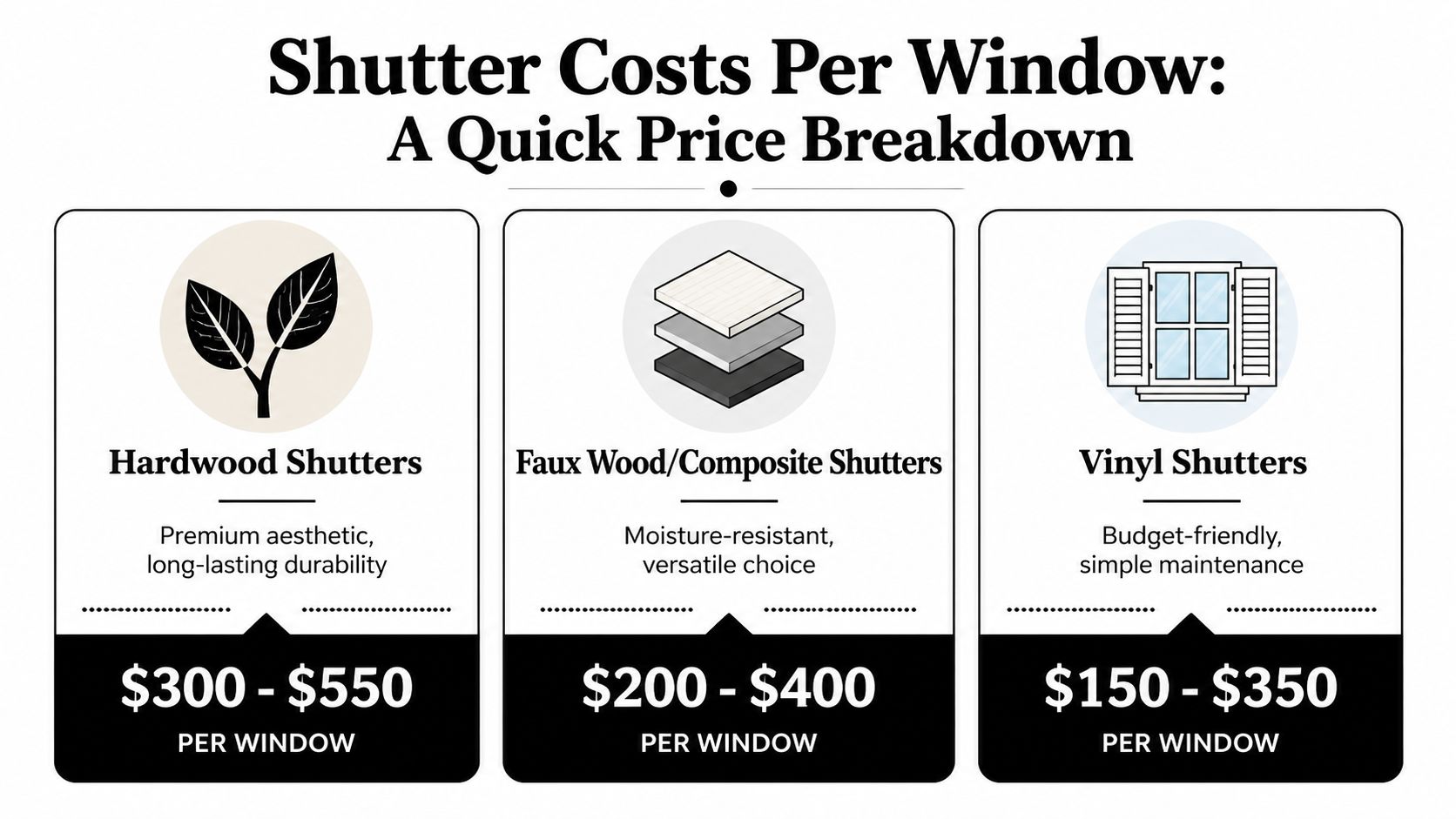
Hardwood shutters
Hardwood sits at the top end for a reason. It looks better than anything else when you want a stained finish, visible grain, or a true furniture-quality feel. Industry pricing published by Bob Vila's shutter cost guide places wood shutters toward the premium side of the market, especially for custom interior plantation styles.
I recommend hardwood for front rooms, dining rooms, home offices, and primary bedrooms where appearance carries the most weight. On larger windows, wood can also feel lighter and more refined than cheaper materials.
I do not recommend it first for bathrooms, laundry rooms, or hard-working kitchens in West Tennessee. Moisture changes the equation.
Faux wood and composite shutters
Composite is the best fit for a lot of homes around Jackson. It gives you the clean, built-in shutter look without asking you to baby the product. It also handles moisture better than real wood, which matters in our climate.
This category usually lands in the middle of the market. Expect pricing above basic vinyl and below premium hardwood in many quotes. Some companies price composite per panel, others per window, so ask that question early or you will end up comparing numbers that are not directly comparable.
For full-house projects, this is usually where I tell homeowners to start. You get strong durability, a consistent painted look, and fewer long-term headaches.
For most West Tennessee homes, composite is the safe recommendation. It looks sharp, holds up well, and does not push the budget as hard as hardwood.
Vinyl shutters
Vinyl is the budget entry point. If the goal is to cover the window at the lowest upfront cost, vinyl can do that. It works best in secondary spaces where you care more about price than about a custom, higher-end finish.
The tradeoff is appearance and feel. Vinyl usually does not give the same solid, refined look that homeowners want in the main living areas or across the front of the house. In a room where guests gather, that difference shows.
If you are comparing materials side by side, this guide to vinyl shutters vs wood will help you sort out where each one makes sense.
2026 Shutter Cost Comparison Per Window
| Material | Average Cost Per Window | Best For | Key Benefit |
|---|---|---|---|
| Hardwood | Premium tier | Living rooms, dining rooms, bedrooms, stained or upscale interiors | Natural beauty and high-end finish |
| Faux Wood or Composite | Mid-range | Kitchens, bathrooms, whole-home installs, family spaces | Moisture resistance and strong long-term value |
| Vinyl | Entry-level | Budget projects, secondary rooms, simple window layouts | Lowest upfront cost |
My recommendation by room
Here is the simple version.
- Front rooms and formal spaces: Choose hardwood if the look matters most.
- Kitchens, baths, laundry, and busy family areas: Choose composite. It is the smartest balance of looks, durability, and cost.
- Secondary windows with a tighter budget: Use vinyl only if you are comfortable with a more basic finish.
That is the story behind the custom price tag. You are not just paying for a shutter that fits the opening. You are paying for a material that matches how that room gets used in a West Tennessee home.
Key Factors That Drive Your Final Shutter Price
Two homes in West Tennessee can both have "ten windows" and end up with very different shutter quotes. One is a clean install with square openings and standard panels. The other has deep trim, a couple of oversized windows, a steamy bathroom, and an older den window that is out of square. That second quote is higher for good reason.
The base material sets the range. The final price comes from what your windows ask the shutter to do.
Window size has the biggest impact
Size drives price fast. A small powder room window uses less material, lighter panels, and less installation time than a wide living room window or a tall front-facing opening.
Bigger shutters also need more structure to stay straight and operate correctly over time. That means heavier panel builds, more support, and tighter alignment during installation. If your home has picture windows, patio doors, bays, or tall feature windows, expect the per-window cost to rise well beyond what you would pay for a standard bedroom opening.
That is one reason big-box pricing frustrates homeowners. The advertised number usually assumes a simple, standard window. Many West Tennessee homes are not that simple.
Room conditions matter just as much as size
A shutter in a dry guest bedroom has an easier job than one over a kitchen sink or beside a shower. Moisture, heat, and direct sun all affect what material makes sense and how long it will keep its shape.
In our part of Tennessee, that matters. Summer humidity is real, and bathrooms, laundry rooms, and kitchens expose weak materials fast. If a room sees steam every morning or strong afternoon sun, spend for a material that can handle it. That choice usually costs more upfront and saves you from disappointment later.
If you are already looking at overall window upkeep, Cultivate HD's window screen guide is a useful read because it helps you budget for the full condition of the window, not just the covering.
My advice: Choose the material for the room first. Then work the budget around that decision.
Shape and panel layout can change a quote quickly
Rectangular windows are the easiest and usually the most affordable. Specialty shapes cost more because they take more shop time and more care on site.
Arches, angles, circles, sidelights, bay configurations, and French door setups all add complexity. So does panel layout. A wide opening may need multiple panels and a different frame design to open smoothly and look right from the street. More panels mean more hinges, more labor, and more time getting everything lined up.
Homeowners often compare windows by square footage alone. That misses the primary driver. Two openings can be close in size and still price very differently if one needs a more involved layout.
Frame style and opening condition affect labor
This part gets overlooked all the time.
A shutter does not install into a perfect drawing. It installs into the actual window opening in your house. In many older West Tennessee homes, those openings are not perfectly square, the casing may be uneven, and the sill may limit your frame options. A good quote accounts for that.
Frame choice affects both appearance and fit. Some openings need a frame that covers minor imperfections cleanly. Others can take a tighter inside-mount look. The right choice depends on depth, trim condition, and whether the window will cooperate without leaving ugly gaps.
Installation quality shows up every day
Shutters are rigid and visible. If the measurements are off, you see it. If the frame is wrong, the panels drag or leave uneven reveals. If the installer cuts corners, the whole product looks cheaper than it is.
That is why installation is part of the shutter price, not an add-on to ignore. You are paying for accurate measuring, correct frame selection, clean alignment, and a finished look that fits the house.
What usually pushes a shutter quote higher
- Oversized windows: More material, heavier construction, and longer install time
- Special shapes: More fabrication and more setup on site
- Moisture-heavy rooms: Better-suited materials cost more than entry-level options
- Multi-panel designs: More hinges, more alignment work, and more hardware
- Difficult openings: Uneven trim, shallow depth, or out-of-square windows raise labor
- Doors and sidelights: More custom fitting than a basic rectangular window
If you want the short version, here it is. Size, shape, room conditions, and installation difficulty drive the number. That is the reason one shutter quote comes in far above another, even before you get into brand names or finish choices.
Calculating Your Own Estimate And Getting a Realistic Quote
A homeowner in Jackson will often call after pricing shutters online and say the same thing: “I found one number on a website, then got a very different quote.” That happens because online pricing skips the details that matter in real West Tennessee homes, especially older houses with trim issues, shallow window depth, or openings that are not perfectly square.
You can still build a useful budget on your own. Just do it the right way.
Start with a room-by-room count
Walk the house and write down every window you want covered in this phase of the project. Keep the list simple:
- Standard windows
- Large windows
- Specialty openings, such as arches, bays, sidelights, and doors
This sounds basic, but it saves people from a common mistake. Homeowners often count the living room, dining room, and bedrooms, then forget the bathroom window over the tub, the kitchen sink window, the stair landing, or the small side windows that still need to match.
Take homeowner measurements for budgeting only
Measure the width and height of each opening in inches. That gives you enough to estimate whether your project is likely to land near entry-level composite pricing or move toward painted wood and more custom work.
If you are also sorting out general window upkeep, Cultivate HD's window screen guide is a useful companion read because it helps you budget for the full condition of the window area, not just the shutter itself.
A rough measurement helps with planning. It does not help you order custom shutters.
Build your own ballpark estimate
Here is the simplest way to do it. Multiply your window count by the price range that fits the material you want from the earlier section. Then add a cushion for the windows that will cost more than average.
For example, if you have 10 standard windows in a Humboldt or Dyersburg home and you are leaning toward composite shutters, use the per-window range from above and multiply by 10. Then add extra room in the budget if you have a patio door, a bay window, deep trim problems, or one oversized front window that will need more material and more install time.
That gets you close enough to decide whether shutters fit your plans this year.
Why online calculators miss the mark
Big-box calculators price products. They do not price your house.
They usually miss things like:
- Out-of-square openings
- Shallow mount depth
- Trim that needs a different frame choice
- Moisture-prone rooms that call for better material
- Door units, sidelights, and bay configurations
- Local install labor and finishing details
That is why the “custom” label feels confusing to so many homeowners. The custom part is not marketing fluff. It is the measuring, frame selection, panel layout, and installation work that makes the shutter look like it belongs on the window instead of sitting on top of it.
If you want a broader comparison before you commit, our guide to blinds vs shutters cost and value will help you sort out the long-term difference.
What a realistic quote should include
A good quote should spell out the material, louver size, frame style, installation, and any upgrades tied to shape or window condition. If a quote looks unusually low, ask what was left out. Around West Tennessee, that missing piece is often installation detail, not the shutter itself.
For an exact number for your home, call (731) 571-5179 and schedule a free in-home consultation. That is the fastest way to get clear pricing, accurate measurements, and a recommendation that fits the room instead of a generic number pulled from a website.
Comparing Shutters to Blinds and Shades Cost Versus Value
Shutters cost more upfront. That's true, and there’s no reason to pretend otherwise. The better question is whether they cost more over time.
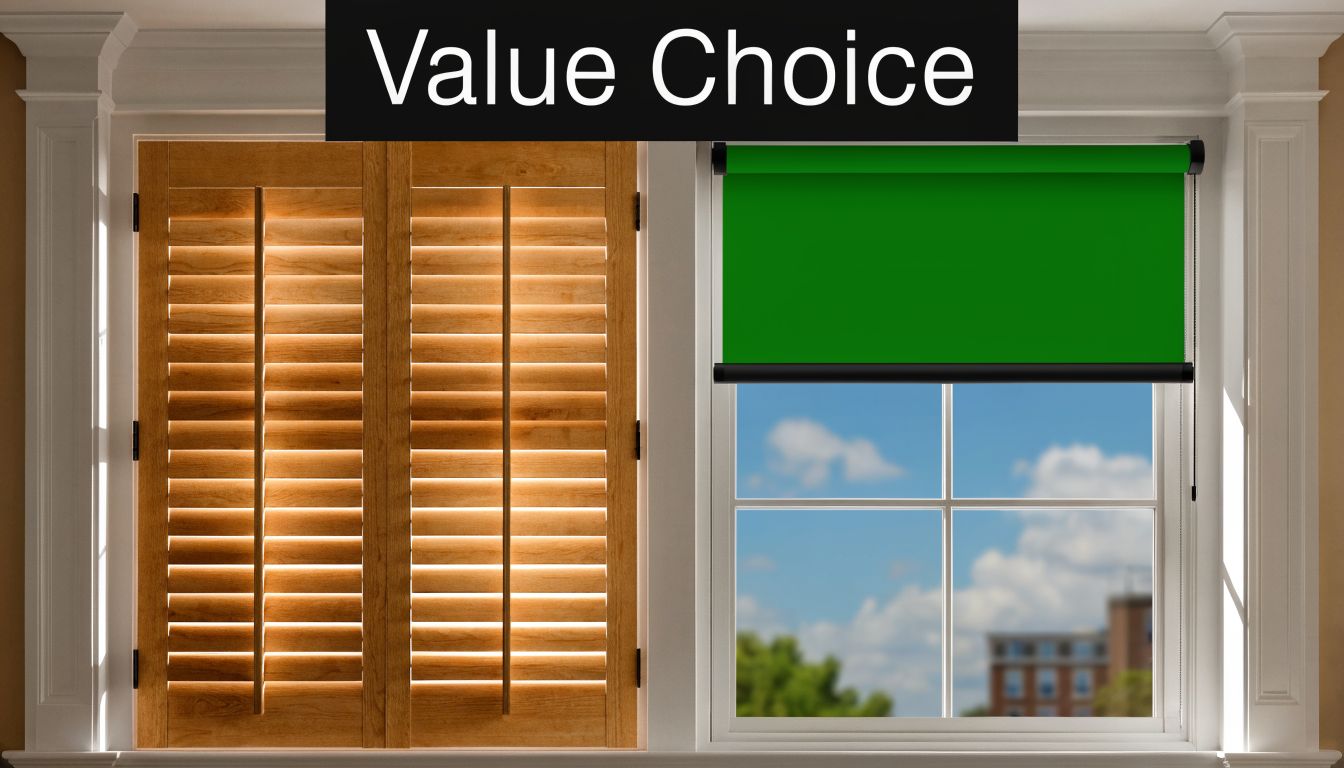
Blinds and shades are easier to buy because the initial number is lower. But lower upfront cost doesn't always mean better value, especially in a long-term home.
Upfront price versus long-term ownership
Verified total-cost-of-ownership data notes that composite shutters can reduce heat loss by up to 40% and last over 25 years, while blinds typically last 5 to 8 years. The same data says a $300 per window shutter could save $50 to $100 annually on HVAC costs in a humid climate like Tennessee's and potentially recoup the investment in 5 to 7 years, according to AAA Blind and Shutter Factory’s cost comparison guide.
That doesn't mean every home gets the exact same result. It does mean shutters should be evaluated like a permanent upgrade, not like a disposable window covering.
Where blinds and shades still make sense
Blinds and shades still have a place. I'd use them when:
- You need a lower upfront cost
- You're finishing a guest room or temporary space
- You want a softer decorative layer instead of a built-in look
- You plan to move soon and don't want a larger project
For rentals, office spaces, and certain low-priority rooms, blinds or shades can be the better call. Not every window needs a premium solution.
Why many homeowners still choose shutters
Shutters win when you want permanence. They look finished. They clean easily. They don't tangle like cords, sag like some shades, or bend like lightweight blinds.
They're also part of the architecture in a way blinds aren't. That changes how the room feels.
If you're weighing which direction fits your house, this local comparison of blinds vs shutters is a helpful side-by-side read.
Here's a quick video that helps visualize the style difference and why the decision often comes down to more than the sticker price.
My opinion on value
If this is your long-term home, shutters are usually the smarter investment for your main living areas. If you're looking for the cheapest way to cover glass, buy blinds. If you want a product that feels built into the home and keeps doing its job year after year, shutters earn their keep.
Buy shutters when you want to improve the house. Buy blinds when you only want to cover the window.
The Blinds Galore Advantage Why Local Expertise Matters
A West Tennessee homeowner orders shutters online because the price looks good. Then the boxes show up, the frame depth is too tight, one window is slightly out of square, and the bright white sample that looked fine on a screen feels wrong against the trim in the living room. Now the "deal" costs more time, more money, and more frustration.
Local help fixes that before you spend a dollar on the wrong product.
A good local shutter specialist measures the actual opening, checks for shallow casing, spots moisture-prone rooms, and recommends materials that make sense for this climate. That advice matters because shutters are a long-term purchase. As noted earlier, they cost more than blinds for a reason. They are built to stay put, look finished, and hold up over years of daily use. Getting the material and fit right is what protects that investment.
What local service does better
- Measures in person: Your quote is based on your windows, not a rough online entry.
- Recommends the right material: Composite usually makes more sense in West Tennessee bathrooms, kitchens, and humid rooms. Real wood belongs where the look justifies the upgrade.
- Matches the finish at your house: Samples look different under your lighting than they do in a showroom or on a phone.
- Owns the install: If a panel rubs, a frame sits off, or something needs adjustment, you call a local team that knows the job.
West Tennessee homes make this even more important. Older houses settle. Trim profiles change from room to room. Two windows that look identical from across the room can measure differently once you put a tape on them. Big-box ordering systems do not catch that. A local installer does.
That is the advantage. You are not paying only for shutters. You are paying for accurate measuring, honest material guidance, cleaner installation, and someone nearby who stands behind the finished result.
If you want straight answers about what your windows will cost, call (731) 571-5179 and talk with someone who works in West Tennessee homes every week.
Your Next Steps to Beautiful Custom Shutters
Shutter pricing gets easier once you strip away the vague marketing. Key drivers include material, window size, room conditions, and how much customization your openings require.
For most homeowners, the best value sits in the middle. Composite shutters usually make the most sense for West Tennessee because they balance appearance, durability, and practical performance. Hardwood still has its place in premium spaces. Vinyl works when budget comes first.
What matters most is getting a quote based on your house, not a national average or a generic online tool. A proper in-home measurement tells you what fits, what performs well in each room, and what the final installed number looks like.
Ready to see how custom plantation shutters can transform your West Tennessee home? Call Mark at (731) 571-5179 to schedule your free, no-obligation in-home estimate and get custom install with 100% satisfaction.
Frequently Asked Questions About Shutter Costs
Are financing options available for plantation shutters
That depends on the dealer and the program they're offering at the time. Many homeowners phase the project by starting with the main living areas first, then adding bedrooms or secondary rooms later. That's often the smartest way to control the budget without dropping to a lower-quality product you'll regret.
How much do shutters help resale value
Shutters are one of the few window treatments buyers often view as a fixture rather than a temporary accessory. That means they usually help the home feel more finished and more upgraded. The exact resale effect varies by home and market, but shutters generally support value better than basic blinds because they stay with the house and look custom.
How long does the process take from consultation to installation
It depends on the product line, the customization level, and the manufacturer schedule. Since shutters are custom built, the process is not instant like buying an off-the-shelf blind. The right expectation is that measuring, ordering, fabrication, and installation all take time, and that's normal for a product built to fit exact openings.
Are there hidden costs I should watch out for
There shouldn't be if the quote is done properly. The common problem is incomplete pricing. Some sellers make the base product sound inexpensive, then the actual cost climbs once measuring, installation, specialty frames, or upgraded materials are added. Ask whether the quote includes the full product, measuring, and custom install.
Should I put shutters on every window at once
Not always. If the full-house number feels too aggressive, start with the rooms that matter most every day. Living rooms, kitchens, dining rooms, and the front-facing windows usually give you the biggest visual return first. Then build from there.
Is faux wood better than real wood in West Tennessee
In many rooms, yes. If the space deals with humidity, heat, or heavy use, faux wood or composite is usually the safer recommendation. Real wood still wins on natural beauty, but it isn't automatically the best answer for every room.
If you're ready for a real number instead of an online guess, talk with Blinds Galore. They serve West Tennessee with free in-home consultations, expert measuring, custom install, and 100% satisfaction. Call (731) 571-5179 and get a shutter quote that fits your windows, your style, and your budget.
You might also like

Best Plantation Shutter Brands – 2026 Review
If you're looking at your windows right now and thinking the room needs more polish, better privacy,
What Are Plantation Shutters Made Of
You're probably looking at a window right now thinking the same thing a lot of West Tennessee homeowners
Contemporary Roman Shades: Modern Styles for Your Home
You know the feeling. Your old blinds work, but they don't do your room any favors. They look hard,

Sliding Glass Window Treatments for Your West TN Home
That sliding glass door probably does two jobs at once in your home. It opens your living space to the
Vertical Blinds vs Horizontal Blinds: The Definitive Homeowner’s Guide
When you're trying to decide between vertical and horizontal blinds, it really comes down to your
Cordless Blinds vs Corded Blinds A Modern Homeowner’s Guide
When you're weighing the pros and cons of cordless blinds vs corded blinds, the verdict for today's