

Best Blinds for Rental Property: A Landlord’s Guide
You know the turnover drill. A tenant moves out, you unlock the door, and the first thing you notice is the window treatment situation. Bent slats. Tangled cords. A few blinds hanging crooked. Maybe one window is bare because somebody yanked the whole thing down.
That is why landlords keep asking about the best blinds for rental property. They are not looking for designer fluff. They want something that survives tenants, looks clean, protects privacy, and does not force another replacement order every time a lease ends.
In West Tennessee, that decision matters more than people think. Heat, humidity, heavy use, and fast turnarounds expose every weak product choice. If you treat blinds like a throwaway line item, they will keep acting like one. If you buy and install the right product once, you cut down on hassle, damage, and repeat labor.
Beyond the Broken Mini-Blind Investing Smarter in Your Rentals
Most landlords start with the same mindset. Buy the cheapest blind, get it up fast, move on. Then turnover happens, and the math stops working.
A busted blind is not just a blind problem. It turns into a cleaning problem, a maintenance problem, and a showing problem. Prospective tenants notice cheap, damaged window coverings immediately. They read it as deferred maintenance.
Stop treating blinds like a disposable purchase
Smart landlords look at blinds the same way they look at flooring, paint finish, and hardware. They are part of the unit’s operating system. If the product fails often, your labor costs rise, your unit shows worse, and your turnover gets slower.
That is why retrofit demand matters here. The global blinds and shades market was valued at USD 14.82 billion in 2024 and is projected to reach USD 24.63 billion by 2030, with retrofit installations accounting for over 57% of revenue according to Grand View Research’s blinds and shades market report. For landlords, that supports a simple point. Existing properties are where the upgrade decisions happen, and blinds are part of that ROI conversation.
The same thinking applies to other rental finishes. If you are also reviewing hard-surface durability, Edinhart Realty and Property Management has a useful piece on best flooring for rental properties that fits the same long-term ownership mindset.
Better rentals use systems, not patch jobs
A rental that rents well usually follows a repeatable standard:
- One durable blind spec: Fewer one-off replacements and less confusion for maintenance crews.
- Neutral finish choices: Easier to match across units.
- Professional measuring: Fewer bad fits, fewer light gaps, fewer reorders.
- Simple cleaning: Faster turn prep.
If you want low-maintenance options, this guide on easy-clean window coverings is worth reviewing: https://blindswesttn.com/blog/easy-to-clean-window-blinds
A blind that costs less at purchase can still cost more in ownership if it fails during every turnover.
Landlords in Jackson and across West Tennessee usually do better when they stop asking, “What is cheapest today?” and start asking, “What will still be working after the next tenant?”
Custom install matters here. So does consistency. If you want someone to measure, order, and handle the fit correctly the first time, call (731) 571-5179. That is the practical route if you are upgrading multiple units and want custom install backed by 100% satisfaction.
The Landlord's Decision Matrix Key Criteria for Rental Blinds
Before you pick a product, use a filter. Landlords who skip that step usually buy based on price alone, then regret it when replacements pile up.
Here is the quick comparison I use when evaluating the best blinds for rental property.
| Blind type | Durability | Cleaning | Safety options | Privacy and light control | Fit for West Tennessee rentals | General verdict |
|---|---|---|---|---|---|---|
| Faux wood blinds | Strong in daily use, handles moisture well | Easy wipe-down | Cordless options are widely available | Very good, especially routeless styles | Excellent | Best all-around choice |
| Aluminum or vinyl mini blinds | Acceptable for budget installs | Easy | Cordless options available | Good basic control | Good for low-cost units | Good if replacement is expected |
| Roller shades | Clean look, fewer slats to bend | Very easy | Cordless options available | Good, depends on fabric | Useful in select rooms | Better in the right application than as a universal standard |
| Cellular shades | Good comfort and appearance | Moderate | Cordless options available | Good privacy | Best where insulation matters most | Better as a premium upgrade |
| Real wood blinds | More vulnerable in humid areas | Moderate | Cordless options may be available | Very good appearance | Poor choice for kitchens and baths | Not ideal for most rentals |
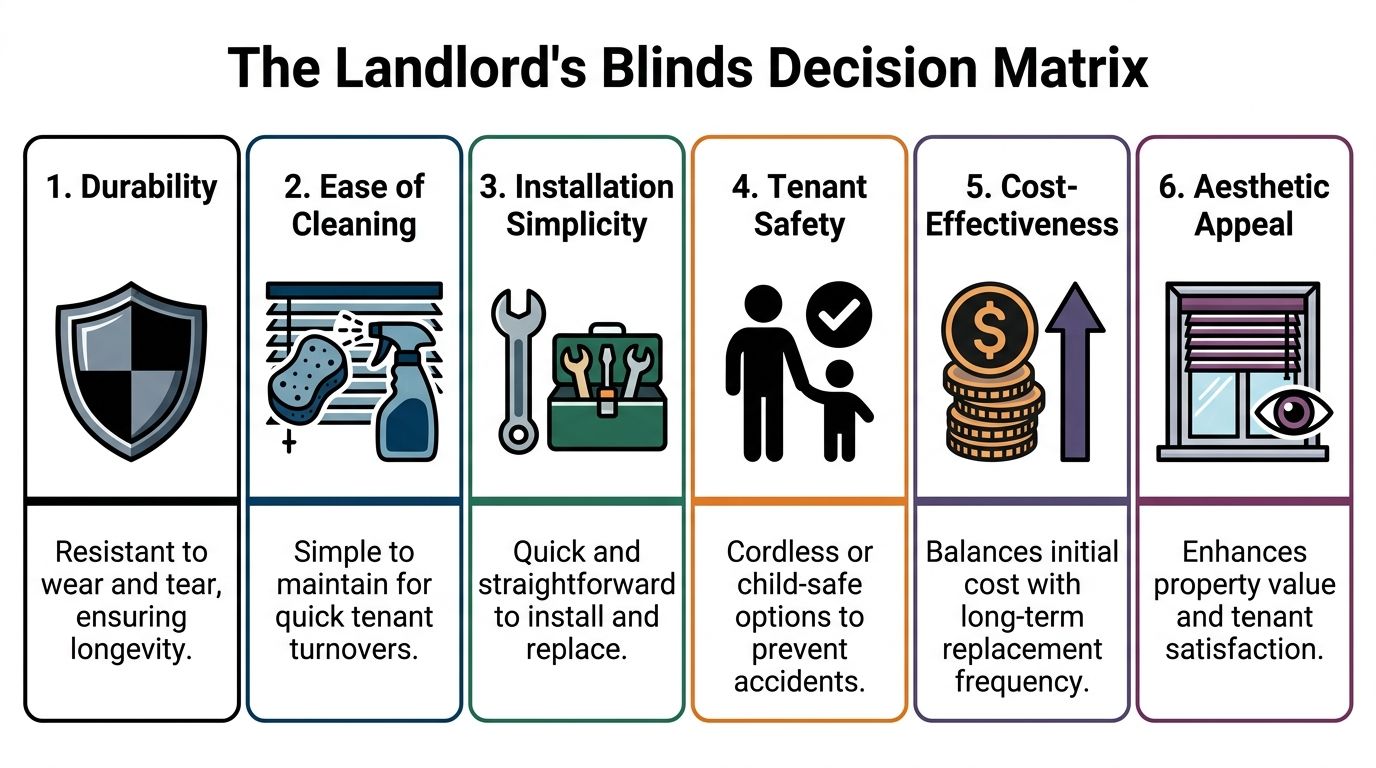
The six criteria that matter
Durability and tenant-proofing
This is the first screen. If a product cannot tolerate repeated opening, closing, dusting, and occasional rough handling, it does not belong in a rental. Slats get bent. Hardware gets pulled. Moisture hits bathroom windows. You need materials that recover from normal tenant behavior instead of failing under it.
Upfront cost versus lifecycle value
Cheap and cost-effective are not the same thing. A blind with a low ticket price but frequent replacement can become the more expensive option over time. Good landlords buy for ownership, not just move-in day.
Ease of cleaning and maintenance
Turnovers move faster when your team can wipe blinds clean instead of wrestling with fabric, delicate finishes, or damaged parts. This matters more than many owners admit. Cleaning time is real money.
Privacy, safety, and local practicality
Privacy and security
Tenants want control over visibility into bedrooms, bathrooms, and street-facing rooms. Landlords want a product that looks uniform from the outside and works every day without fuss.
Energy efficiency in a humid climate
West Tennessee summers are tough on interiors. Window coverings that reduce heat transfer and hold up in humidity help more than flimsy products that warp or stain. If you are comparing treatments room by room, this piece on how to choose window coverings is useful: https://blindswesttn.com/blog/how-to-choose-window-treatments
Ease of installation and replacement
A rental blind should be straightforward to measure, order, and replace. Standardization across units saves headaches. One consistent spec is easier to stock, repair, and explain to maintenance staff.
For landlords reviewing multiple unit finishes at the same time, this landlord's guide to the best flooring for rental properties is another good example of thinking in systems instead of one-off cosmetic choices.
If a blind fails your durability, cleaning, and safety test, do not let aesthetics rescue it.
Comparing the Top Contenders for Your Rental Property
Some products look fine in a showroom and disappoint in a rental. Others are not flashy, but they earn their keep every lease cycle. That is the difference that matters.
Faux wood blinds
Faux wood sits at the top of the list for a reason. It gives you a clean, familiar look without the weakness of real wood in damp or high-use spaces. In rental property terms, that is a strong combination of appearance and durability.
Management-focused guidance consistently points landlords toward faux wood for exactly that reason. Management One’s rental property window covering guide notes that faux wood and metal blinds are top choices for rentals due to durability, and that standard miniblinds offer a low-cost, 4-year lifespan.
For West Tennessee rentals, faux wood is especially useful in kitchens, bathrooms, laundry areas, and any room that gets hard daily use. Moisture resistance matters. So does easy cleaning.
Where faux wood wins:
- Humidity resistance: Better suited than real wood in damp rooms.
- Appearance: Neutral, broad tenant appeal.
- Maintenance: Wipes clean with little effort.
- Consistency: Easy to standardize across units.
Where faux wood loses:
- Upfront cost: Higher than bargain mini blinds.
- Weight: Heavier product, so accurate measuring and solid installation matter more.
If you want one blind type that works in most rental rooms without constant regret, choose faux wood.
Aluminum and vinyl mini blinds
Mini blinds stay in the conversation because they are cheap, familiar, and easy to replace. That is the honest answer. They are not glamorous, but they still make sense in some units.
They are a reasonable fit when your priority is the lowest upfront spend, especially in basic rentals where appearance is secondary to speed and cost control. Their biggest advantage is simple economics at the front end.
Their biggest weakness is also obvious. Slats bend. Hardware wears out. They tend to look tired faster. Still, for non-slider windows in budget-sensitive units, they can work.
Best use cases for mini blinds:
- Lower-rent units
- Quick turns where budget controls everything
- Rooms where replacement is accepted as part of normal turnover
Less ideal use cases:
- Higher-end rentals
- Large, prominent living room windows
- Units where you want a more durable long-term standard
Metal versions generally outperform flimsy plastic versions in day-to-day use. If you are going the mini-blind route, do not buy the weakest product on the shelf and expect it to hold up.
Roller shades
Roller shades are cleaner looking than many landlords expect. They fit modern interiors well and are easier to wipe down than a lot of people realize. They also eliminate the bent-slat issue entirely.
That said, they are not my first choice as a universal rental standard. Their success depends heavily on fabric selection, light-filtering level, and operating mechanism. A good roller shade can look sharp. A cheap one can look temporary.
They work best where you want a clean look or where the unit style supports a more contemporary finish. They are also useful in spaces where slat cleaning is a nuisance.
Why landlords choose roller shades:
- Simple visual profile: Clean and uncluttered.
- Fast cleaning: Fewer moving parts and no slats.
- Good fit for modern units: Especially in living rooms and offices.
Why some landlords avoid them:
- Fabric choices matter a lot.
- Damage can be less forgiving than with hard-slat blinds.
- Not always the strongest option for rough tenant handling.
Cellular shades
Cellular shades deserve respect, but they are not the automatic winner for rentals. They help with comfort and can improve the feel of a room. In the right unit, they add value.
The issue is ownership practicality. They are usually not the first product I would install across a whole portfolio unless the property and tenant profile justify it. They are better as a selective upgrade than a blanket standard.
Cellular shades make more sense in bedrooms, upper-end units, or rooms where temperature control is a bigger concern. They are less ideal where rough treatment and frequent resets are expected.
My practical ranking
If a landlord asks me for a straight answer, I rank them like this for general rental use:
- Faux wood blinds
- Metal mini blinds
- Roller shades
- Cellular shades
- Real wood blinds
That ranking is about ownership, not décor. The best blinds for rental property are the ones that survive use, clean up quickly, and do not create repeat work.
Beyond Aesthetics Managing Liability and Safety with Your Blinds
A blind is not just a furnishing choice. It is also a liability decision.
Most online advice stops at durability and price. That misses a major issue for landlords. Corded blinds introduce avoidable risk, especially in homes where children or pets may be present.

Lloyd’s Blinds notes this clearly in its rental property guidance. The underserved issue is how blind selection affects insurance, liability exposure, and compliance with safety standards such as those from the CPSC. Landlords should take that seriously.
Cordless should be your default
If you are still installing corded blinds in rentals when a cordless option is available, you are making the wrong tradeoff. The small savings are not worth the safety exposure.
Cordless blinds do three important jobs at once:
- They reduce visible hazards
- They simplify operation for tenants
- They help present the unit as updated and safety-conscious
That matters in family rentals. It matters in multifamily buildings. It matters in any property where you want fewer avoidable problems.
Documentation matters too
Good risk management is not just buying the safer product. It is also keeping records.
Hold onto:
- Product specifications
- Installation records
- Invoices showing cordless selection
- Warranty documents
- Maintenance and replacement notes
If a question comes up later, documentation helps show that you made a reasonable, safety-minded choice and installed the product properly.
Landlords should treat cordless blinds as a standard operating policy, not an upgrade option.
Accessibility and local rules deserve attention
Not every rental owner thinks about accessibility until a problem lands in their lap. That is backwards. Easy-to-operate window coverings can make a unit easier to use for more tenants and reduce complaints about basic function.
Local building requirements, insurance expectations, and lease standards can vary. That is why blanket internet advice often falls apart when applied to a real portfolio. A landlord in West Tennessee should confirm what applies to their specific property type, tenant profile, and municipality.
This short video is worth watching if child safety is part of your decision.
Liability is part of ROI
Owners usually calculate ROI in materials and labor. They should also calculate it in risk reduction. A safer blind can prevent tenant complaints, reduce exposure, and lower the chance that a small choice turns into a serious issue.
That is not theory. It is routine property management discipline.
Budgeting for Blinds Calculating Your Total Cost of Ownership
Most landlords compare blind options the wrong way. They look at the invoice total and stop there.
That approach ignores total cost of ownership, which is the cost that shows up after installation. Replacement labor, cleaning time, damage frequency, and ease of service matter just as much as purchase price.
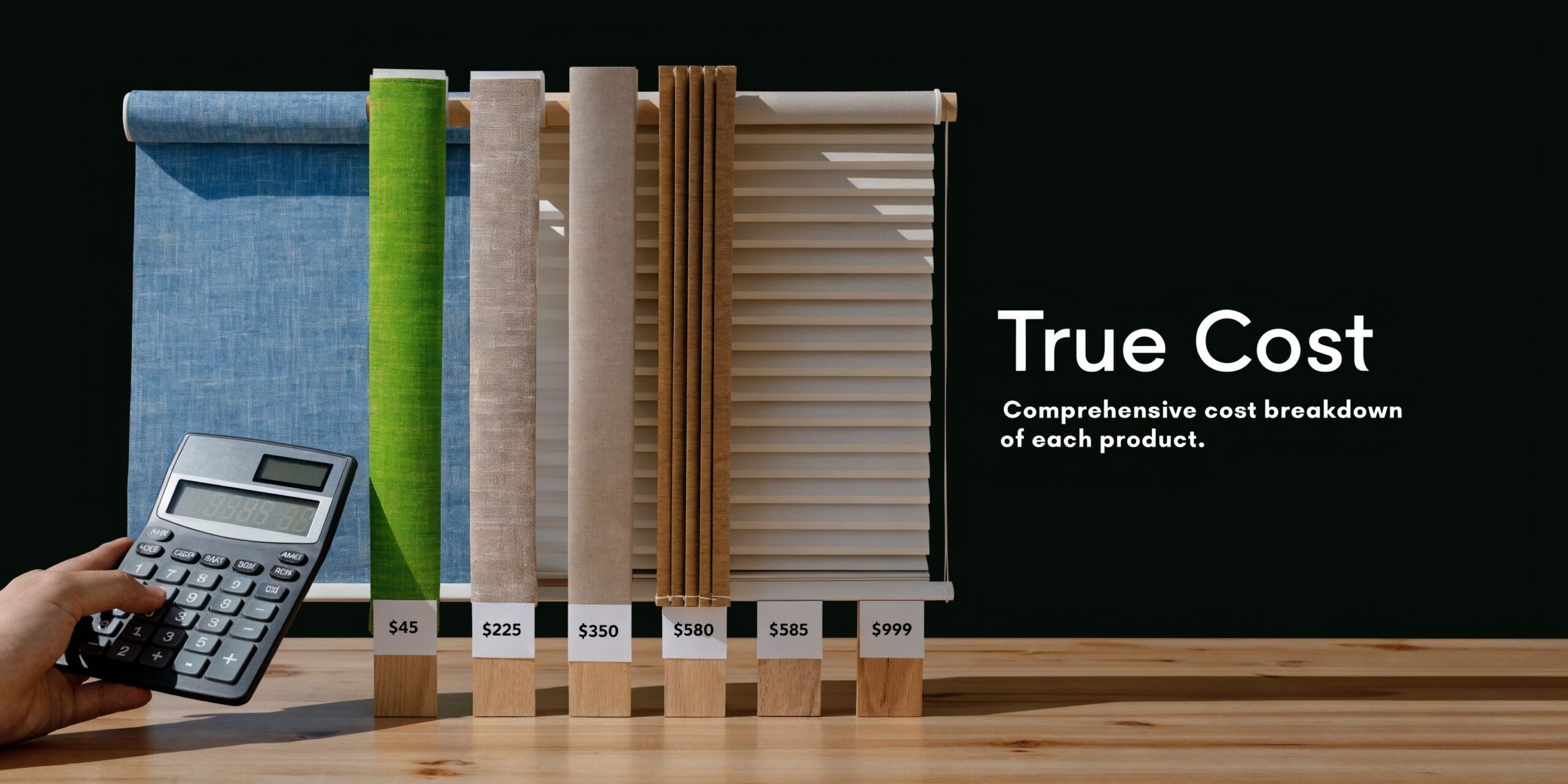
One of the biggest gaps in rental blind advice is exactly this issue. SelectBlinds points out that existing content lacks a quantitative comparison of total cost of ownership, including replacement frequency, maintenance costs, and energy-efficiency ROI. That gap is why landlords keep repeating bad buying decisions.
What belongs in your TCO calculation
Use a simple worksheet. For each blind type, consider:
- Purchase cost: What you pay for the product
- Install cost: Your labor or a professional installer’s labor
- Cleaning burden: How long it takes to prep between tenants
- Failure pattern: What usually breaks first and how often
- Replacement hassle: How difficult it is to match and reorder
- Tenant-facing appearance: Whether it still looks good after normal use
Why cheap blinds often lose
A low-end blind can look like the winner on day one. Then slats bend, brackets fail, or the product starts looking worn long before the unit itself does. The replacement cycle gets shorter. The labor repeats. The unit shows worse.
A better blind usually wins because it reduces interruptions. That is the ownership logic landlords should use.
Here is a practical comparison framework:
| TCO factor | Budget mini blinds | Faux wood blinds |
|---|---|---|
| Upfront spend | Lower | Higher |
| Cleaning time | Low | Low |
| Resistance to moisture | Basic to moderate | Strong |
| Appearance after use | Declines faster | Holds up better |
| Replacement rhythm | More frequent | Less frequent |
| Best fit | Tight budgets | Standard portfolio spec |
The right question is not “What costs less today?” It is “What requires less money and less hassle across multiple lease cycles?”
Professional install protects the math
A blind that is measured wrong or mounted poorly can erase the savings you thought you were getting. Bad fit creates light gaps, strain on hardware, and rework. That is why professional measuring and installation often make financial sense, especially across several units.
If you are comparing local service options and trying to keep costs under control, this page is relevant: https://blindswesttn.com/blog/affordable-blinds-near-me
Landlords who standardize product, color, and install method usually get the cleanest TCO picture. They know what they are buying, they know how it performs, and they know how to replace it without starting from scratch every time.
Our Recommendation The Best All-Around Blinds for West Tennessee Rentals
For most landlords in Jackson and across West Tennessee, my recommendation is simple. Install 2-inch cordless faux wood blinds and stop overcomplicating the decision.
They cover the most ground with the fewest compromises. They handle moisture better than real wood. They clean fast. They look substantial enough for a decent rental. They hold up under repeated tenant use. They also put you in a better position on safety when you choose cordless.
The product details back that up. According to Blindsgalore’s guide for high-turnover rentals, faux wood blinds made from moisture-resistant PVC slats can feature routeless designs that block up to 99% more light, maintain structural integrity after 5+ years of simulated heavy use, and their low thermal conductivity can minimize heat transfer by 15-20% in humid climates like West Tennessee summers.
Where I would use them
They make sense in:
- Living rooms: Clean look, good privacy control
- Bedrooms: Better light blocking with the right design
- Bathrooms: Moisture resistance matters
- Kitchens and laundry rooms: Easier maintenance than real wood
I would not waste time trying to make real wood work in rough-use rental conditions. It is the wrong product for the job in most units.
The practical way to buy them
Do not guess on measurements. Do not assume big-box sizes will fit well. Rental windows are rarely as uniform as landlords hope, especially in older properties.
One local option for that process is Blinds Galore, which provides in-home measuring, product selection, and installation for custom window coverings in West Tennessee. That matters when you want a repeatable spec across multiple units.
If you want the straightforward route, schedule the work, get the right fit, and move on. Call (731) 571-5179 for custom install and a 100% satisfaction promise.
Frequently Asked Questions for Landlords
Are plantation shutters a good investment for rentals
Usually, no. They look great, but most rentals do not need that level of finish, and many portfolios do not benefit from tying up more money in a window treatment that can still be damaged by hard use. Shutters fit better in owner-occupied homes or select premium rentals.
Should I let tenants install their own curtains
Only if your lease language is clear. If tenants add hardware without approval, you can end up with wall damage, uneven installations, and a patchwork look from the street. Set a written rule on whether they can add curtain rods, what they can mount, and who restores the wall at move-out.
Are cordless blinds legally required
That depends on product type, property context, and applicable standards. But from a landlord standpoint, cordless should be treated as the practical default. It is the safer choice and the smarter risk decision, even when a specific legal mandate is not the issue.
What is the fastest way to handle tenant-damaged blinds
Standardize your product line. Use one or two approved blind specs across your rentals, keep records on sizes, and replace damaged units with the same finish and hardware. That avoids delay and keeps the property looking consistent.
What if I have sliders or large openings
Use a product designed for that span. For many rentals, vertical blinds or a suitable faux blind option make more sense than forcing a standard horizontal blind into a bad application. Large openings need function first.
Is professional installation worth it for rentals
Yes, especially if you manage more than one unit. Accurate measuring, correct brackets, and clean installation reduce callbacks and help the blinds last longer. You also avoid the common mistake of buying a decent product and ruining the value with a sloppy install.
If you are updating rentals in Jackson or anywhere in West Tennessee, Blinds Galore offers English-language service with in-home measuring, individualized product recommendations, custom install, and a 100% satisfaction commitment. Call (731) 571-5179 to schedule a free in-home consultation and get a rental-ready blind package that fits your units correctly the first time.
You might also like

Best Blinds for Energy Efficiency: A Tennessee Guide
When your living room feels too hot by midafternoon in July, or one chair by the window stays chilly
Get a Perfect Fit: How to Measure for Plantation Shutters
You’re probably staring at a window right now, trying to decide whether plantation shutters will look

Affordable Blinds Near Me | Get a Free Quote Today
The search starts the same way. You notice the late afternoon glare in the living room, the bedroom feels

Automatic Hurricane Shutters: West TN Buyer’s Guide
A lot of West Tennessee homeowners know this feeling. The sky turns greenish, the weather app starts

Your Guide to Automatic Storm Shutters
Imagine this: a storm warning flashes across your screen. Instead of a mad dash for plywood and tools,

The Guide to Bottom Up Window Blinds
Have you ever found yourself wanting to let some natural light into your living room, but not at the