

How to Measure Windows for Blinds a DIY Guide to the Perfect Fit
Getting your window measurements right is the absolute most important first step. I can’t stress this enough. The difference between blinds that look sleek and custom-fit versus a frustrating DIY mess often comes down to just a fraction of an inch.
When you measure correctly, your new blinds fit perfectly, operate smoothly, and give you the exact light control and privacy you were hoping for. For a guaranteed perfect fit with a professional custom install and 100% satisfaction, call Blinds Galore at (731) 571-5179.
Why Precise Measurements Are Key to Flawless Blinds
Think of your measurements as the foundation for the entire project. If the foundation is off, everything that comes after will be a struggle. An ill-fitting blind doesn’t just look sloppy—it simply doesn’t do its job.
Custom blinds are made to order based on the exact dimensions you provide. If you’re going for an inside mount and your width measurement is even slightly too big, the blind just won’t go in. Too narrow? Now you’ve got annoying gaps on the sides letting in light and compromising your privacy. It’s all about achieving that professional-grade finish that truly elevates your home.
The Impact of Precision on Your Home
When you nail the measurements, you unlock all the benefits you’re paying for.
- Optimal Light Control: The right fit means no light leaks around the edges. You get total command over how bright or dark the room is.
- Enhanced Privacy: A perfect fit means no peeking through gaps. You get the security and seclusion you need.
- Improved Energy Efficiency: Properly fitted blinds act as an insulator, helping to keep your home warmer in the winter and cooler in the summer. We’ve got a great guide on how custom blinds from Blinds Galore can limit your electric bill.
- Flawless Aesthetics: Nothing beats the clean, seamless look of a blind that fits the window frame perfectly. It makes the whole room look more put-together.
This is the kind of detail we obsess over. After more than 18 years serving West Tennessee, we’ve seen firsthand how a few millimeters can be the difference between “good enough” and “perfect.” And this principle doesn’t just apply to blinds; learning how to measure window screen size like a pro uses the same core idea of accuracy to prevent headaches.
When to Skip the DIY and Call Us
Look, we’re here to help you get it right if you want to tackle it yourself. But sometimes, it’s just better to call in a pro. If you’re dealing with tricky bay windows, massive picture windows, soaring ceilings, or you just want a guaranteed-perfect result without the stress, let us handle it.
At Blinds Galore, we believe you shouldn’t have to sweat the small stuff. That’s why we offer a completely free, professional in-home measuring service. Our team takes full responsibility for every measurement, ensuring your custom install is flawless.
We bring our experience right to your home, and we back it up with our 100% satisfaction promise. Let’s make sure the first step is the right one. For total peace of mind and a perfect fit, just call Blinds Galore at (731) 571-5179 to set up your complimentary consultation.
Gathering Your Essential Window Measuring Tools
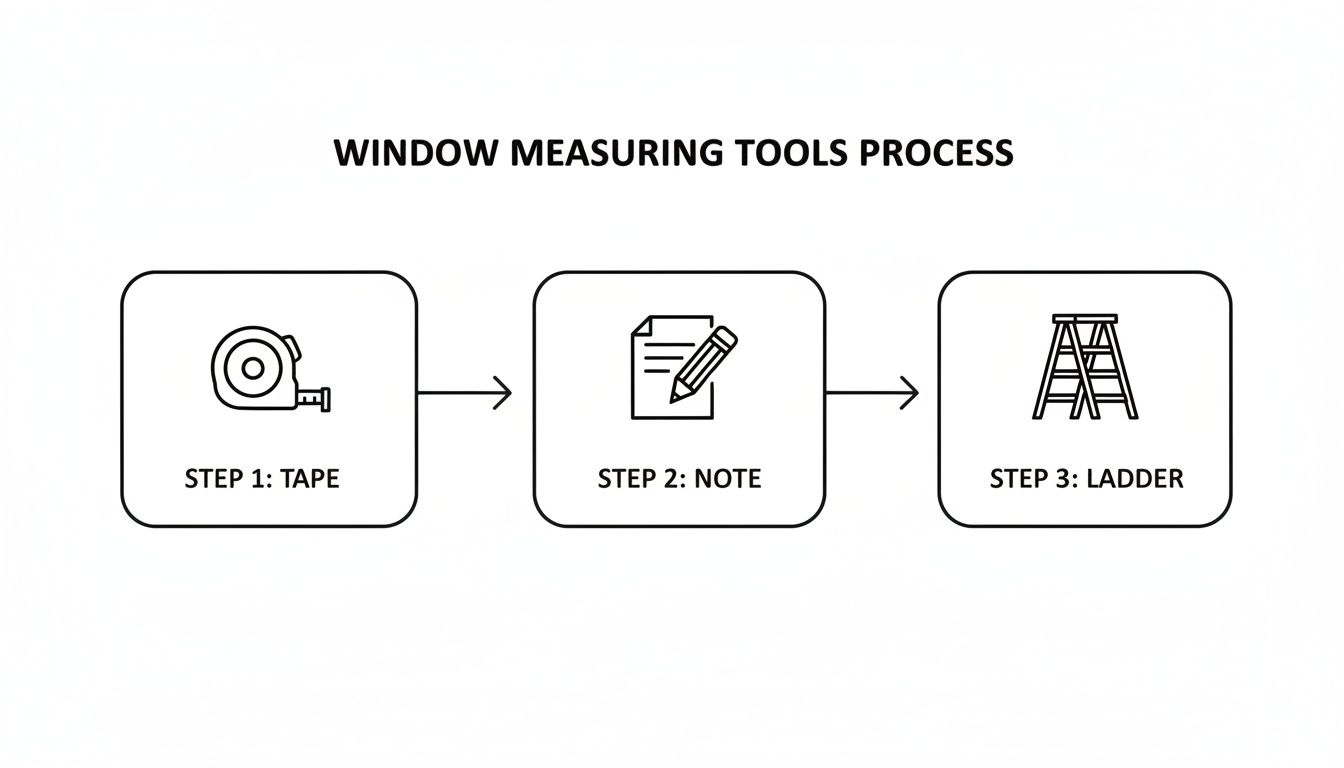
Before you even think about grabbing a ladder, let’s talk tools. Using the right gear for measuring your windows isn’t just about making the job easier—it’s about locking in accuracy from the very first pull of the tape. Being prepared is half the battle won.
The most critical tool you’ll have is a steel tape measure. Don’t even think about using a cloth or fabric one. Those things can stretch and sag, leading to tiny errors that cause big headaches later. A solid, retractable steel tape gives you a perfectly straight line every time, which is exactly what you need to measure for blinds like a pro.
You’ll need a few other simple things to round out your kit:
- A Pencil: Make sure it’s sharp and ready to go.
- A Notepad: This is where you’ll keep all your measurements organized. Be sure to label which numbers go with which window!
- A Sturdy Ladder: Safety first, always. You need a step ladder that’s stable enough to let you reach the top of the window frame without any wobbling.
Why Every Fraction of an Inch Matters
It might seem like a tiny detail, but measuring down to the nearest 1/8th of an inch is what separates a professional, custom-fit look from a costly mistake. For a snug, perfect fit, that level of precision is non-negotiable.
Did you know that getting your measurements spot-on can save homeowners up to 20-30% on their custom blinds? It’s true. Inaccurate measurements often lead to returns and remakes, a surprisingly common issue. Industry stats show that around 15% of custom blind orders need adjustments because of DIY measuring errors. In a global market projected to hit US$119.2 billion by 2032, that’s a significant number. You can find more insights on the global window blinds market on Persistence Market Research.
Our professional installers at Blinds Galore actually rely on laser measures. These tools give us flawless digital readouts, which is how we can confidently back every custom install with our 100% satisfaction guarantee. We take on the full responsibility of getting it perfect for you.
Now, you don’t need to run out and buy a laser measure for your project. The point is that precision is everything. Taking your time with a quality steel tape measure will give you the confidence you need to get it done right.
And if you ever feel unsure, just remember that a quick call to Blinds Galore at (731) 571-5179 brings our expert team—and their professional tools—right to your door for a free consultation. We’ll guarantee a flawless fit, every single time.
How to Measure for an Inside Mount
An inside mount gives you that clean, built-in look where the blind sits perfectly inside the window frame, showing off your beautiful trim. It’s a popular choice, but getting it right comes down to precise measurements. The key to success is a simple but critical rule you absolutely cannot skip: measure everything in three places.
Why? Because almost no window frame is perfectly square. Even tiny variations can mean your blinds won’t fit or operate smoothly. Following this process guarantees your custom blinds are made to fit the unique dimensions of your window, not a generic one.
Before you even start, get your tools ready. A good steel tape measure, a pencil and paper, and a sturdy step ladder are all you’ll need.
Measuring the Width Correctly
Let’s start with the width of the window opening. Grab your steel tape measure and prepare to take three separate horizontal measurements inside the frame.
- Measure the Top: Place your tape measure inside the very top of the window frame and stretch it from the left side to the right. Jot that number down.
- Measure the Middle: Now, move down to the center of the window and do the exact same thing. Measure from one side to the other.
- Measure the Bottom: Finally, drop your tape to the bottom of the opening, right near the sill, and take your last width measurement.
Now, look at those three numbers. Record the narrowest of the three measurements. This is the most important part of the whole process. If you give us the widest number, your blinds will be too big to fit into the narrower spots. The smallest dimension ensures the blind will fit perfectly and move freely without catching.
Getting the Height Measurement Right
Once you’ve got your final width, you’ll use the same three-point method for the height. This time, of course, you’ll be taking vertical measurements.
- Measure the Left Side: Run your tape measure from the top inside edge of the frame down to the windowsill on the far left.
- Measure the Center: Move to the middle of the window and measure from top to bottom again.
- Measure the Right Side: Take your third and final measurement on the far right side of the window.
Just like with the width, review your three height measurements. For height, you will record the shortest of the three measurements. This prevents the blind from bunching up at the bottom or scraping against the sill when you operate it.
For a quick reference, here is a simple cheat sheet to keep handy.
Inside Mount Measurement Cheat Sheet
| Measurement Type | Where to Measure | Which Measurement to Record |
|---|---|---|
| Width | Top, middle, and bottom of the window frame interior. | The narrowest of the three width measurements. |
| Height | Left, center, and right side of the window frame interior. | The shortest of the three height measurements. |
| Depth | From the front of the window frame to the glass. | The full depth available, to ensure the blind fits. |
Following these simple rules is the secret to getting a flawless inside mount.
The Most Important Tip: Never Make Deductions
Here is a piece of advice that has saved countless DIY projects from disaster: never, ever make your own deductions from the measurements you take. Your only job is to provide us with the “tight” measurements—the narrowest width and shortest height—rounded to the nearest 1/8th of an inch.
The manufacturer is the expert here. Companies like Graber and Norman have perfected the formulas to account for the headrail, brackets, and all the moving parts. They will make the precise, small deductions needed to ensure your custom blinds fit and function flawlessly.
When you try to subtract a little yourself, you almost always end up with blinds that are too small. This creates ugly light gaps on the sides and hurts your privacy. Trust the process and let the professionals handle the math. If you want to see how different products are supposed to look, you can explore our product videos.
Don’t Forget to Check Window Depth
One last check for an inside mount is the window depth. Measure from the front edge of your window frame straight back to the glass or any obstruction like a handle or crank. Every blind has a minimum depth requirement for its headrail to be fully recessed and look flush.
If your window frame is too shallow, the headrail will stick out. That’s okay! It just means an outside mount will be a better and more attractive option for that particular window.
If any of this feels like a hassle, or if you just want to guarantee a perfect result without the guesswork, our Blinds Galore team is ready to step in. We offer a free in-home consultation where we perform the custom install measurements for you, backed by our 100% satisfaction promise. Just call us at (731) 414-8585 to schedule a visit and leave the tape measure to us.
How to Measure for an Outside Mount
While an inside mount gives you that sleek, built-in look, sometimes an outside mount is the perfect—and only—solution. It’s a fantastic choice for hiding less-than-perfect window frames, maximizing light blockage, or for windows that simply don’t have enough depth for an inside mount.
With this style, the blinds are installed on the wall or trim above and around the window, giving you a completely different aesthetic.
Measuring for an outside mount is less about rigid rules and more about personal preference, but there are still some key guidelines to get it right. You have a lot more flexibility here, and you can even use this technique to make your windows appear larger and more dramatic.
The main goal is simple: create a generous overlap on all sides of the window frame. This is what stops light from seeping in around the edges and gives you total privacy.
Determining the Perfect Width
First things first, let’s figure out the width. Start by measuring the full width of your window, including the trim. Go from the absolute outer edge of the trim on the left to the outer edge on the right. If your window doesn’t have any trim, just measure the opening itself.
Now for the most important part: adding the overlap. This step is crucial for getting the coverage you want.
- The General Rule: For the best light control and privacy, plan on adding a minimum of 2 to 4 inches to each side of that base measurement. So, if your window frame is 36 inches wide, you’ll add 4 to 8 inches in total, making your final blind width somewhere between 40 and 44 inches.
- An Aesthetic Choice: Don’t be afraid to go a bit wider if you have the wall space. More overlap often creates a more substantial, high-end look.
This added width is what makes an outside mount so effective. Ever seen new blinds that leave annoying light gaps? This common mistake affects nearly 25% of DIY installations. In fact, studies show a proper outside mount, with that crucial 2-4 inches of extra width, can block up to 95% more light than an inside mount. You can find more insights on the global demand for window treatments at Data Bridge Market Research.
Nailing the Height Measurement
Next up is the height. This measurement is your secret weapon for influencing the feel of the room. By mounting the blind higher above the frame, you can create a visual trick that makes your ceilings seem taller and the whole space feel more grand.
Start by measuring the full height of your window frame, from the very top edge of the upper trim down to the bottom edge of the lower sill.
Now, you have to decide where you’ll actually mount the blind. Here are your options:
- Mounting on the Trim: If you have nice, thick trim with at least 2 inches of flat surface, you can mount the headrail directly onto it.
- Mounting Above the Trim: For that more dramatic, ceiling-lifting effect, you’ll mount the headrail on the wall above the window. A great starting point is to add 2 to 4 inches above the top of the window frame.
For the bottom, you need to decide where the blinds will end. If you have a windowsill that sticks out, you’ll want to measure to the top of the sill so the blind can rest neatly on it. If there’s no sill or you want the blind to fall below it, add at least 2 inches to your height measurement to ensure complete coverage.
Pro Tip: When mounting above the frame, use a pencil to lightly mark where the top of the headrail will go. Then, measure from that mark all the way down to where you want the blind to end (the sill or below). This final number is the exact height you’ll order.
Putting It All Together for a Flawless Custom Install
Let’s walk through a real-world example. Say your window frame measures 40 inches wide and 60 inches high, including the trim. You’re aiming for maximum light blockage and a taller look.
- Width Calculation: You take your 40-inch frame width and decide to add 3 inches to each side. (40″ + 3″ + 3″ = 46″). That’s your final order width.
- Height Calculation: You want to mount the blind 4 inches above the top trim and have it extend 2 inches below the bottom. (4″ above + 60″ frame + 2″ below = 66″). That’s your final order height.
By carefully planning this overlap, you get a beautiful result that functions perfectly. And if you’re ever unsure about how much to add or where to mount, that’s exactly what we’re here for.
At Blinds Galore, we provide free in-home consultations where we handle all the measuring for you. Our expert custom install service is backed by a 100% satisfaction guarantee, so you never have to worry about a thing. Give us a call at (731) 571-5179 and let us make sure your new blinds are absolutely perfect.
Measuring Tricky Windows Like Bay Windows and Doors
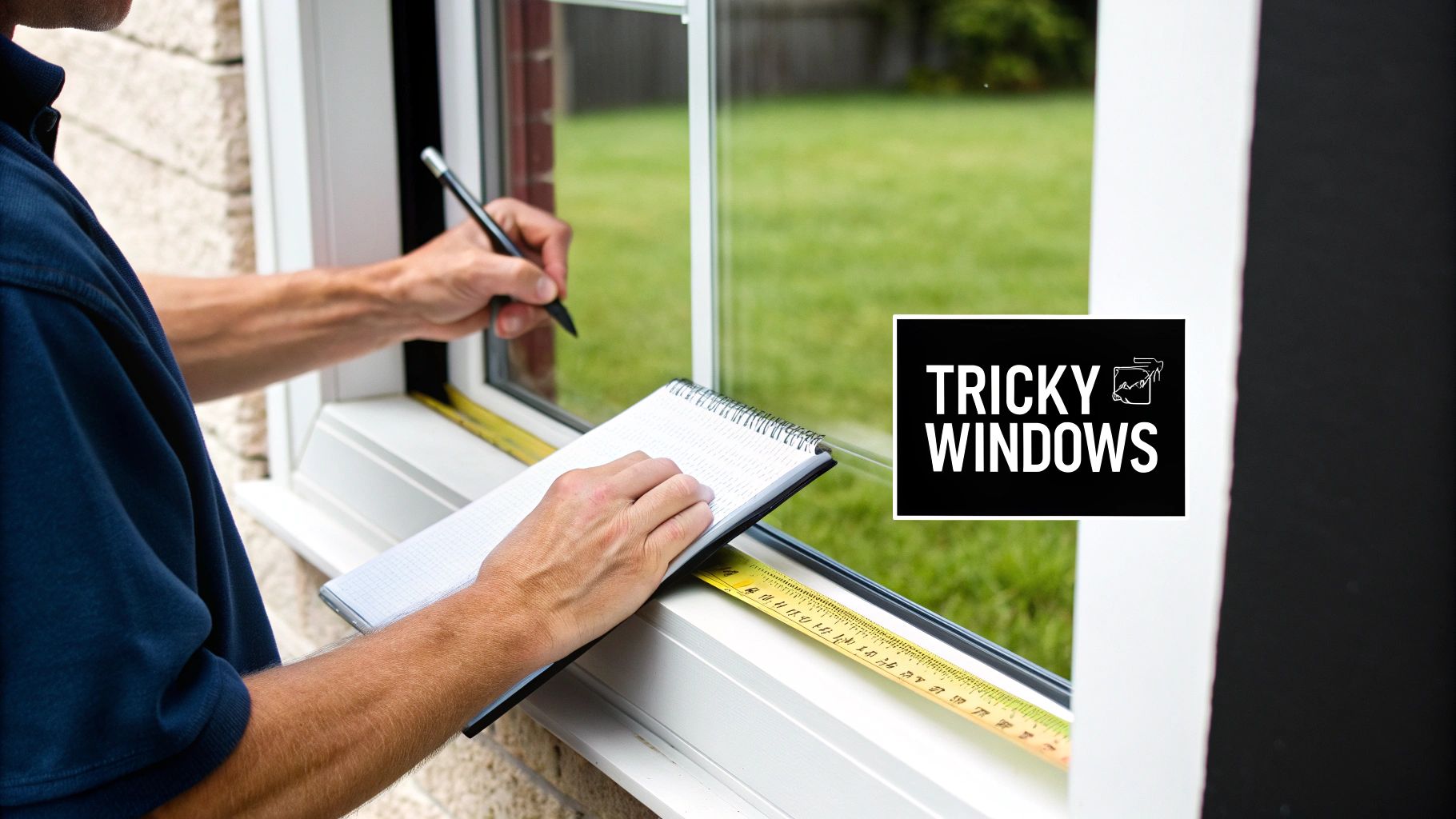
Standard rectangular windows are pretty straightforward. But what happens when you’re faced with a beautiful bay window, elegant French doors, or a tricky corner window? These architectural features add so much character to a home, but they can be intimidating to measure.
Don’t worry, you can get it right. The key is to treat each window panel as its own individual project while always thinking about how they’ll fit together. Drawing from our hands-on experience across West Tennessee, we’ll walk you through the practical advice you need to handle these complex situations without the headaches.
Conquering the Angles of a Bay Window
Bay windows are stunning, but their angles require a methodical approach. The goal here is to make sure each blind can operate smoothly without its headrail or fabric bumping into its neighbor. A small miscalculation at the corner can cause the whole setup to fail.
First, decide if you’ll be using an inside or outside mount for each of the three (or more) sections. This decision is often made for you by the window’s depth, especially at the corners where things get tight.
Here’s our process for getting it right:
- Measure Each Panel Separately: Treat the center window and each side window as three distinct units. Just use the inside or outside mount techniques we’ve already covered for each one.
- Check That Corner Depth: Pay very close attention to the available depth where the windows meet at an angle. For an inside mount, you absolutely must have enough room for the headrails to meet without sticking out past the frame.
- Start in the Middle: For inside mounts, always measure the large center window panel first. When you measure the side panels, make a specific note of the tightest point where the blinds will almost touch.
This is one of the trickiest parts of any DIY blind installation. If the window frames are nearly touching at the angles, you might need to order the side blinds just a fraction of an inch narrower to allow for clearance. It’s exactly these kinds of details where professional experience really makes a difference.
Addressing Corner Windows and French Doors
Corner windows and French doors bring their own unique puzzles to solve. With corner windows, the headrails have to meet perfectly at a 90-degree angle without interfering with each other. For French doors, the big concerns are clearing the door handle and making sure the blinds don’t flap around every time you open the door.
For Corner Windows:
You’ll need to decide which blind will run all the way into the corner and which one will butt up against it. Typically, one blind is measured to fit the full width of its window. The second blind is then measured from the other wall to the headrail of the first blind, not to the wall. This requires a careful deduction for the headrail’s depth to avoid a gap.
For French Doors:
An outside mount is almost always your best bet.
- Start by measuring the width and height of the glass panel itself.
- Add 1 to 2 inches of overlap on all four sides. This is crucial for blocking light leaks and ensuring privacy.
- Double-check the depth of the blind you’re considering to make sure it won’t get in the way of the door handle. Slim-profile blinds or shades are often the perfect solution here.
- Here’s a pro tip: Order your blinds with hold-down brackets. These secure the bottom rail to the door and stop them from swinging wildly.
When to Call for a Perfect Custom Install
Measuring tricky windows is where small errors can lead to big, expensive problems. In fact, inaccurate measurements contribute to 10-20% of the $1-2 billion in annual waste within the global blinds industry. Professionals know that for bay windows, nearly 70% of errors come from getting the angles wrong. With roller blinds expected to claim over a third of the $7.01 billion market by 2025, the demand for a perfect fit has never been higher. You can find more market trends for blinds and shades at Future Market Insights.
If you’re looking at a complex window and feel even a little unsure, that’s the perfect time to call in an expert. Our team at Blinds Galore specializes in these exact scenarios. We offer a free in-home consultation where we take on all the measuring. It’s no-obligation, and we assume all the risk.
Our custom install service is backed by our 100% satisfaction guarantee, ensuring a flawless result every time. For a perfect fit on any window, call Blinds Galore today at (731) 571-5179.
Common Questions We Hear All the Time
As you get ready to measure, a few questions always seem to pop up. We’ve been helping homeowners with this for years, and we’ve heard them all. Let’s clear up some of the most common hangups so you can get this done right the first time.
Should I Make Deductions for an Inside Mount?
Absolutely not. Your only job is to get us the exact, “tight” measurement of that window opening. Record it down to the nearest 1/8th of an inch, and we’ll handle the rest.
Our manufacturers are the pros here—they know precisely how much space to deduct for the headrail and all the moving parts to work smoothly. If you try to guess, you’ll almost always end up with blinds that are too small, leaving you with those annoying light gaps on the sides.
What if My Window Widths Aren’t the Same?
Don’t worry, this is completely normal. In fact, perfectly square window frames are incredibly rare.
For an inside mount, you always use the narrowest width measurement you took. This is non-negotiable. It ensures the blind will fit into the tightest point of the frame without scraping, jamming, or getting stuck. For an outside mount, this isn’t a big deal since you’re covering the whole frame anyway.
This exact scenario is why the “measure in three places” rule is so critical. It accounts for these small imperfections and ensures a smooth, functional fit every time, which is a core principle of every professional custom install.
What if My Window Is Too Shallow for an Inside Mount?
This is a common issue, especially in older homes. If the window frame isn’t deep enough to hold the blind’s headrail, an outside mount is the perfect fix.
By mounting the blind on the wall or trim above the window, you completely sidestep the depth problem. It’s a great way to get the style you want while also giving you even better light control since it covers the entire opening.
When Should I Just Call a Professional?
Honestly, it’s smart to call in an expert if you’re dealing with anything tricky. Think massive picture windows, windows that are two stories high, or odd shapes like arches and angles. Or, if you simply want a guaranteed perfect result without the hassle, that’s what we’re here for.
We can also walk you through options that go beyond basic blinds, especially when you need to unlock the perfect shutter solution with custom experts.
Here at Blinds Galore, we offer a totally free in-home measuring service across West Tennessee. We take on all the responsibility for accuracy, making sure your new custom blinds fit flawlessly. With our 100% satisfaction guarantee, you get total peace of mind and a beautiful result. Give us a call at (731) 571-5179 to set it up.
Ready to skip the guesswork and get perfect blinds? Let the experts at Blinds Galore handle all the measuring and installation for you. Visit us at https://blindswesttn.com to schedule your free in-home consultation today.
You might also like

“Get the Perfect Shutter Installation: Reach Us Today for Customized Solutions!”
Benefits of Professional Shutter Installation Services Are you looking to enhance the aesthetic appeal

The Best Window Treatments For Kitchens That Actually Last
When it comes to the heart of your home, the best window treatments are the ones that can handle the

The Best Blinds for Bathrooms That Handle Moisture and Privacy
The absolute best blinds for bathrooms are the ones built from moisture-proof materials like faux wood,

What Are Vertical Blinds A Complete Homeowner Guide
If you've ever found yourself with a massive picture window or a sliding glass door, you know that

What Are Faux Wood Blinds A Complete Homeowner’s Guide
So, what exactly are faux wood blinds? Think of them as the smarter, tougher cousin of real wood blinds

Faux Wood Blinds Vs Real Wood Blinds A Complete Comparison
It really all boils down to one thing: finding the right balance between the look you want and what your