


Window Covering Ideas for Front Door: Style & Privacy
The front door usually tells the whole story of a house in the first few seconds. In West Tennessee, it also takes a beating from sun, humidity, muddy shoes, kids running in and out, and dogs who think every delivery is a major event.
A bare glass insert or exposed sidelights can make that entry feel unfinished fast. You get glare in the afternoon, silhouettes at night, and a front hall that never quite feels comfortable. The good news is that the fix doesn't have to be complicated. The right front door covering can give you privacy, better light control, a cleaner look from the curb, and a lot less daily irritation.
Your Front Door Is More Than Just an Entrance
A lot of homeowners start thinking about front door glass after the same moment. They open the door in late afternoon, the light is harsh, the foyer feels hot, and anyone walking up the sidewalk can see straight in.
That problem shows up in different ways around West Tennessee. In Jackson, it might be a bright entry that fades rugs and makes the lockset too warm to touch. In Milan or Dyersburg, it might be sidelights that look pretty from the street but leave you feeling exposed after dark.
What homeowners usually want
Most front entry projects come down to a few practical goals.
- More privacy: You want daylight in, but you don't want a clear view from the porch into the living room.
- Less heat and glare: Entry glass catches strong light at exactly the wrong times of day.
- A finished look: Bare door glass can make an otherwise polished home feel incomplete.
- Something that stays put: On a working front door, flimsy products twist, bang, and wear out quickly.
For narrow glass beside the door, these sidelight window covering ideas are useful because sidelights almost always need a different approach than a standard window.
Bare front door glass isn't just a design issue. It's a comfort, privacy, and daily-use issue.
The biggest mistake I see is treating the front door like just another window. It isn't. It opens and shuts all day. It has hardware to work around. It gets touched, bumped, and noticed more than almost any opening in the house.
That's why window covering ideas for front door spaces have to do more than look good in a photo. They need to operate cleanly, hold up to use, and still make the entry feel welcoming.
Defining Your Front Door's Purpose Before You Shop
Before you pick a style, decide what job the covering needs to do first. A good-looking product that solves the wrong problem is still the wrong product.
Start with the one thing that bothers you most
Ask yourself which of these is causing the most frustration right now.
- Heat and glare
- Privacy
- Appearance from inside and outside
- Ease of use on a busy entry door
If heat is the issue, the numbers are worth knowing. According to the U.S. Department of Energy, approximately 30% of a home's heating energy is lost through windows, and 76% of sunlight that hits standard double-pane windows enters as heat. The same source notes that the right covering can reduce solar heat gain by up to 45% and can contribute to 10% to 20% savings on annual energy bills in climates like West Tennessee (U.S. Department of Energy guidance on energy-efficient window coverings).
Match the purpose to the product
If privacy is the priority, think about when you need it.
- Daytime privacy: Decorative film, solar materials, and light-filtering shades can help while still letting in daylight.
- Night privacy: You'll usually need a more opaque solution, or louvers that close tightly.
- Adjustable privacy: Shutters and some shades give you more control through the day.
If style matters most, decide what kind of statement you want the entry to make.
- A traditional brick home often looks natural with shutters or faux-wood styles.
- A simpler modern entry usually pairs better with clean-lined roller or cellular shades.
- Decorative film works when you want the glass itself to stay visually prominent.
For a broader design framework, this guide on how to choose window treatments helps narrow down what fits your home and how you live in it.
A practical way to decide
I usually tell homeowners to rank these in order.
| Priority | Questions to ask |
|---|---|
| Privacy | Can people see in at night when the lights are on? |
| Light control | Do you want filtered light or near blackout at the entry? |
| Door function | Will the product stay steady when the door opens and closes? |
| Maintenance | Can you wipe it down easily? |
| Style | Does it fit the rest of the home? |
Practical rule: Pick for function first at the front door. Style choices get easier once the daily-use problem is solved.
Some homes need one answer for the main glass and another for sidelights. That's normal. There isn't one universal best option. There is only the right fit for your exact door, your traffic pattern, and your comfort level.
A Guide to Front Door Window Covering Styles
The most useful window covering ideas for front door areas usually fall into five groups. Each one solves a different mix of privacy, light control, durability, and appearance.
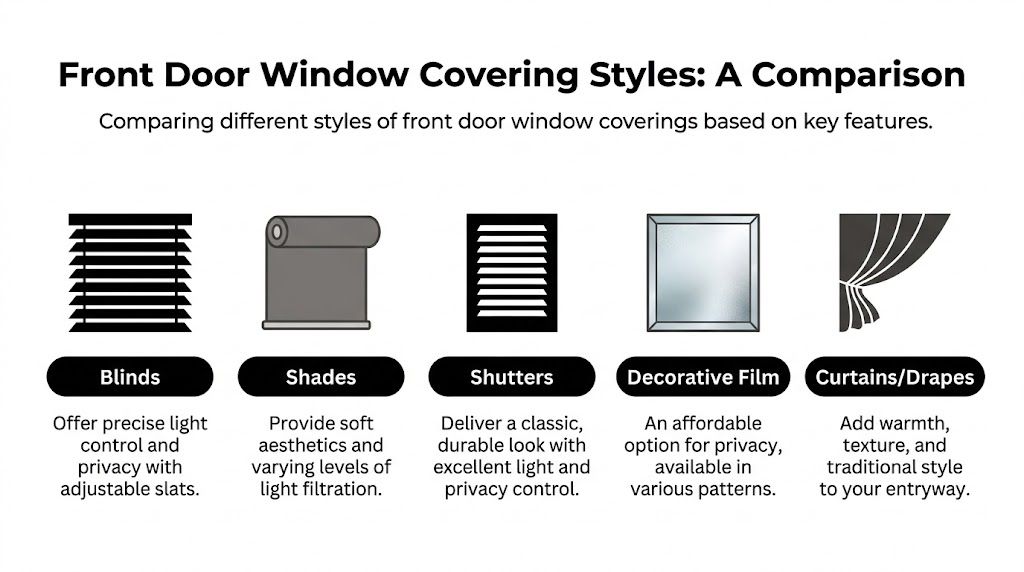
Front door window covering comparison
| Covering Type | Best For | Privacy Level | Durability | Style |
|---|---|---|---|---|
| Cellular shades | Energy control, narrow glass, soft look | High, depending on fabric | Good with proper brackets | Clean and tailored |
| Plantation shutters | Long-term durability, classic curb appeal | High | Very high | Timeless |
| Roller or solar shades | Glare control, modern interiors | Varies by fabric | Good | Minimal and sleek |
| Decorative film | Simple privacy without bulk | Moderate to high depending on film | Good on the glass itself | Subtle |
| Curtains or drapes | Softness and decorative layering | Moderate to high depending on fabric | Fair at a front door | Traditional |
Plantation shutters
Shutters are one of the strongest choices for an active front entry because they look built-in and take wear well. They also suit homes that need a more architectural finish rather than a fabric look.
Composite plantation shutters are especially practical in this part of Tennessee. According to the cited guidance, composite shutters offer 5x the impact resistance of real wood, resist warping with less than 0.5% moisture expansion, and can deliver a 20+ year lifespan when professionally installed with details like hidden tilt rods and corrosion-resistant hinges (technical notes on modern front door window coverings and composite shutters).
What works well:
- Narrow sidelights: Custom panels can be made for slim openings.
- Busy households: No loose fabric to grab or snag.
- Homes with humidity: Composite materials handle moisture better than real wood.
What doesn't work as well:
- Very shallow mounting depth.
- Homeowners who want a soft, fabric-based look.
Cellular shades
Cellular shades are the quiet workhorses of front door glass. They sit closer to the opening, look neat, and help with insulation because of the honeycomb construction.
For doors, the details matter. A proper door shade needs the right headrail profile and bottom hold-downs so it doesn't swing every time the door opens. Light-filtering fabrics are useful when you want privacy without making the entry feel closed off.
This is also where product quality matters. Blinds Galore offers custom-fit options from lines such as Norman and Graber, which is useful when the door glass is narrow, slightly out of square, or interrupted by handles and locks.
Roller and solar shades
These are strong options when glare is the main complaint. Roller shades give a flat, uncluttered look. Solar shades help preserve a more open feel because they don't visually bulk up the glass area as much.
They fit well in:
- Painted fiberglass entry doors
- Modern farmhouses
- Homes with transoms where too much visual detail would feel busy
Their trade-off is simple. They don't usually give the same sculpted, architectural look as shutters, and some fabrics are less forgiving in homes with pets or sticky fingers.
Decorative film
Film is the simplest answer when you want privacy and don't need an operable treatment. Frosted and patterned films work well on glass inserts that don't need daily adjustment.
I like film when the homeowner says, "I want to stop the direct view, but I still want the glass to be the feature."
Film isn't the right answer for every door, though. It doesn't give the same flexibility as a shade or shutter, and if glare is severe, it may not address the whole problem on its own.
Curtains and drapes
Front door curtains can work, but they are usually the most temperamental option at an entry. They can snag, shift, and collect dust fast.
They make the most sense when:
- The door is rarely used
- The house has a more formal interior
- The covering is part of a layered decorative plan
For homeowners also dealing with insects at frequently opened entries, it's worth looking at practical doorway add-ons like fly screens for doors, especially in warm months when fresh air and front-door traffic tend to go together.
Shutters usually win on durability. Cellular shades often win on softness and insulation. Film wins on simplicity.
Durable Solutions for Homes with Pets and Children
A front door covering can look perfect on install day and still be the wrong choice for your house. If you've got dogs that jump at the glass, children pulling on anything within reach, or constant in-and-out traffic, durability moves to the top of the list.
What holds up in real life
Some coverings handle active homes better.
- Composite shutters: They resist scratching better than delicate fabrics and wipe down easily.
- Cordless shades: They avoid dangling cords that become both a safety concern and a constant temptation.
- Simple, smooth surfaces: The easier it is to clean, the more likely it will still look good six months later.
The key point from the available guidance is straightforward. Standard window coverings often fail in high-traffic entryways, while cordless systems and durable materials like faux-wood composites are better suited to homes with pets and children because they reduce safety hazards and are easier to clean (front door window covering guidance for active households).
What usually fails first
Fabric-heavy treatments are often the first to show wear at a front door. They collect handprints, can catch claws, and don't always recover their shape if they're pushed aside repeatedly.
Mini blinds can also become frustrating in this location. The slats bend, the bottom rail swings, and the whole setup can start looking tired before the rest of the room does.
If your front door is part of the daily race of backpacks, groceries, leashes, and muddy shoes, choose the product you'd be least worried about cleaning on a Tuesday night.
A quick visual on safety and practical setup helps here:
Smart choices for active households
If I were narrowing it down for a family home, I'd focus on these filters first.
- Choose cordless first if kids or pets are around the entry.
- Pick wipe-clean materials over textured fabrics when the door gets heavy use.
- Avoid anything that swings loosely unless it's specifically designed for door mounting.
- Think about visibility out if you want to monitor the porch without leaving the door exposed.
The right answer isn't always the fanciest one. It's the one that still looks right after repeated use, fast cleanups, and years of everyday traffic.
Ensuring a Perfect Fit The Custom Installation Advantage
Front doors are where DIY measuring mistakes show up immediately. The glass may be narrow, the frame may not be perfectly square, and the hardware often steals the exact clearance a shade or shutter needs.
Why custom measurement matters
On a standard room window, a small measuring error can be annoying. On a front door, it can make the product unusable.
That matters most with cellular shades mounted directly on the door. The verified installation guidance notes that hold-down brackets prevent 90% of swinging and banging issues, and that professional installation success rates exceed 98% compared with 65% for DIY attempts, largely because the measurements account for hardware and mounting constraints (installation notes for front door cellular shades).
What a proper install actually includes
A good custom install usually involves more than just writing down width and height.
- Checking hardware clearance: Lever handles, deadbolts, and trim can interfere with operation.
- Choosing the right mount: Inside mount looks cleaner when depth allows it. Outside mount can solve clearance issues.
- Selecting the correct headrail profile: Doors need compact, stable components.
- Securing the bottom: Hold-down brackets matter on moving doors.
- Testing operation repeatedly: A front door treatment has to work smoothly every day, not just once.
If you're curious how measuring differs from regular windows, this guide on how to measure windows for blinds gives a useful baseline. Front doors usually need even more attention because of trim, swing path, and lock placement.
Why off-the-shelf rarely satisfies
People often assume their door glass is a standard size. Sometimes it is. A lot of times it isn't.
Even broad references like Australian standard window sizes are a reminder that size standards vary by market and application, which is exactly why front door inserts and sidelights should be measured individually instead of guessed.
A front door treatment should look like it belongs to the door, not like it was adapted to fit after the fact.
This is where custom install earns its keep. A free in-home consultation lets someone measure the door correctly, bring actual samples to the house, and spot the issues most homeowners won't see until the box is already open.
For West Tennessee homeowners, that means less trial and error and a lot less frustration. If you want a custom install with 100% satisfaction, call (731) 571-5179 before you order anything for the front entry.
Transform Your Entryway with Confidence Today
The right front door covering changes more than the glass. It changes how the entry feels when you walk in, how comfortable that space stays through the day, and how much privacy you have at night.
Some homes need the clean insulation and soft look of cellular shades. Others need the structure and durability of composite shutters. Busy households often need a solution that can take paw prints, handprints, and constant motion without becoming another thing to fuss over.
Keep your decision grounded in daily use
A good choice usually comes from three questions.
- What problem are you solving first
- How much wear will this opening take
- Do you want a decorative finish or a hard-working solution
If you answer those truthfully, the options get narrower fast.
Local experience matters
West Tennessee homes have their own mix of heat, humidity, and heavy-use entryways. That's why front door treatments here need to do real work. They need to fit right, operate cleanly, and hold up in homes that aren't staged for a catalog.
The simplest next step is to see materials in your own light, against your own trim color, on your own door. That's how you avoid guessing.
If you're ready to stop living with exposed entry glass, awkward glare, or a treatment that never sat right, call (731) 571-5179 and get clear answers before you buy.
If you're considering new window covering ideas for front door glass, sidelights, or transoms, contact Blinds Galore for a free in-home consultation, custom install, and 100% satisfaction. Call (731) 571-5179 to get started.
You might also like

Best Plantation Shutter Brands – 2026 Review
If you're looking at your windows right now and thinking the room needs more polish, better privacy,

What Are Plantation Shutters Made Of
You're probably looking at a window right now thinking the same thing a lot of West Tennessee homeowners
Contemporary Roman Shades: Modern Styles for Your Home
You know the feeling. Your old blinds work, but they don't do your room any favors. They look hard,
Sliding Glass Window Treatments for Your West TN Home
That sliding glass door probably does two jobs at once in your home. It opens your living space to the

Vertical Blinds vs Horizontal Blinds: The Definitive Homeowner’s Guide
When you're trying to decide between vertical and horizontal blinds, it really comes down to your
Cordless Blinds vs Corded Blinds A Modern Homeowner’s Guide
When you're weighing the pros and cons of cordless blinds vs corded blinds, the verdict for today's