

Best Motorized Blinds for Large Windows in Jackson, TN: Cost and Control Guide
Quick answer: Motorized blinds are the most practical solution for large windows in Jackson, TN homes, eliminating the hassle of reaching tall or wide window treatments while adding smart-home convenience and energy savings. Expect to invest between $300 and $900 per window for a quality motorized system, depending on size, fabric, and control technology. Battery-powered, hardwired, and solar-powered motors are all available. The best choice depends on your window dimensions, existing smart-home setup, and budget — and a free in-home consultation from a local specialist makes the decision much easier.
Why Large Windows in Jackson, TN Demand a Smarter Solution
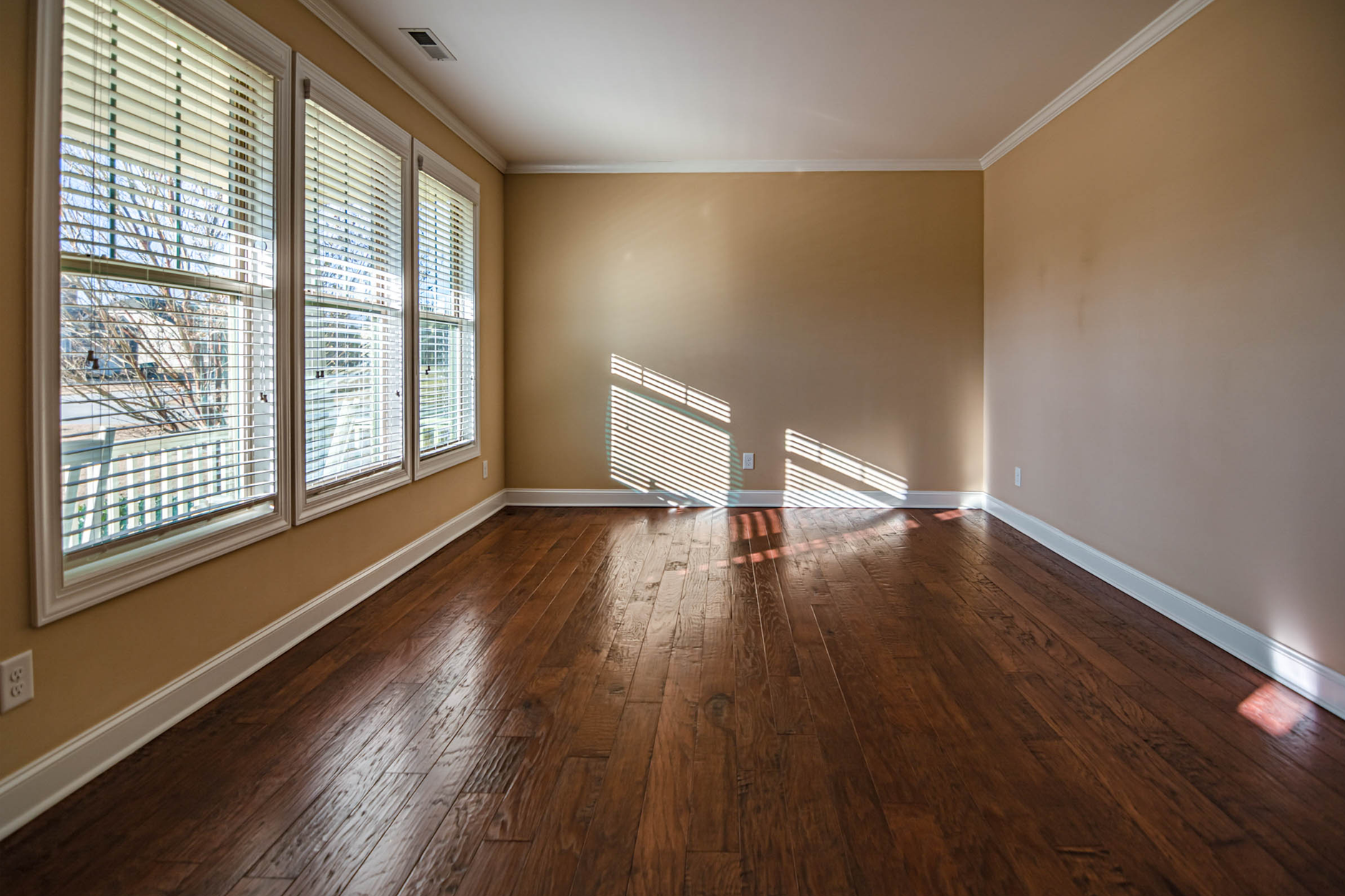
Not every window treatment works at scale. When a window spans more than 72 inches wide or rises above 84 inches tall, the physics of manual operation start working against you — and that’s before you factor in the Tennessee heat pouring through unshaded glass. Motorized blinds were engineered precisely for these situations, and Jackson, TN homeowners are discovering them in growing numbers.
The Challenge of Oversized Windows
Jackson, TN and the surrounding West Tennessee communities — Lexington, Henderson, Milan — are full of homes built with generous, light-filled floor plans. Open-concept great rooms, vaulted ceilings, and sunrooms often feature windows that stretch 8, 10, or even 12 feet wide. Traditional corded or wand-operated blinds simply weren’t designed for these proportions. Reaching a 10-foot-wide shade to tug a cord is awkward at best and a safety hazard at worst, especially in households with young children or older adults.
Beyond convenience, large windows in West Tennessee face a real climate challenge. Jackson summers routinely push past 95°F, and unshaded south- or west-facing glass can raise interior temperatures by 10–15°F, forcing air conditioners to work significantly harder. The right motorized treatment, precisely controlled to the minute, can meaningfully cut cooling costs.
Why Motorization Changes Everything
Motorized blinds solve the reach problem entirely. A single tap on a remote, a voice command to Alexa or Google Home, or a scheduled automation lowers every large window treatment simultaneously — no ladders, no tangled cords, no uneven pulls. For homeowners with two-story great rooms or specialty-shaped transom windows, this isn’t a luxury upgrade; it’s the only practical option.
Modern motors are whisper-quiet (many operate below 35 dB), hold precise stop positions, and integrate with virtually every smart-home ecosystem. Battery-powered models require no electrician, while hardwired systems offer unlimited run time. Either way, the installation footprint on a large window is clean, cordless, and child-safe — a requirement under current window-covering safety standards.
1. Understanding Motorized Blind Types for Large Windows
Before comparing costs and control systems, it helps to understand which motorized product category best suits your specific large window. The three dominant types each have distinct strengths in terms of light control, insulation, aesthetics, and maximum width capability.
Motorized Roller Shades
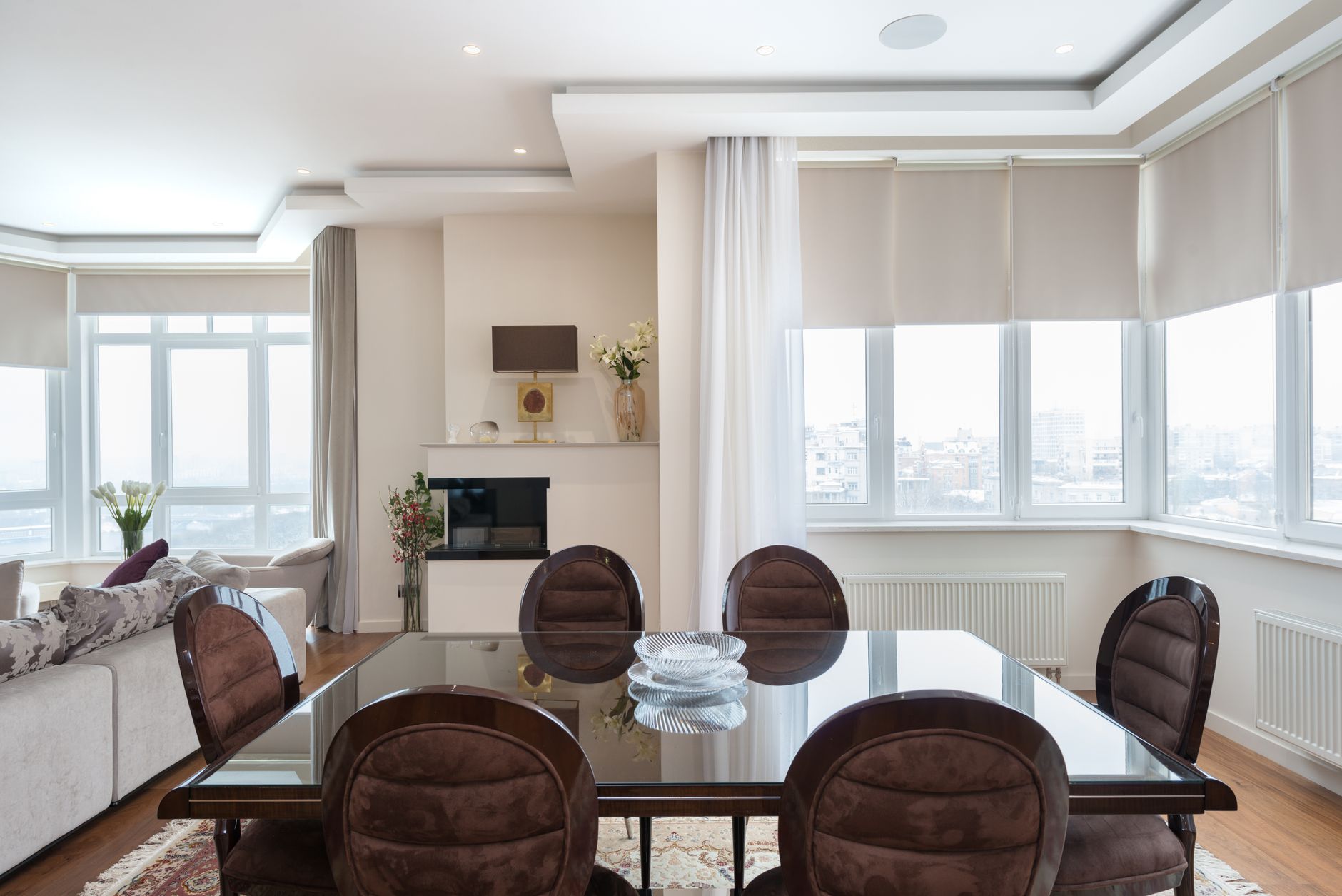
Roller shades are the most popular motorized option for large windows because the fabric rolls onto a single tube, keeping the mechanism compact even at widths of 144 inches or more. Fabric choices range from sheer solar screens (1%–14% openness factor) that filter glare while preserving the view, to room-darkening and blackout fabrics ideal for media rooms and bedrooms. In Jackson’s sunny climate, a solar screen with a 3%–5% openness factor on south-facing windows can block up to 95% of UV rays while maintaining outward visibility. Motors are concealed inside the headrail tube, giving the finished product a sleek, minimal look that suits both traditional and contemporary West Tennessee interiors.
Motorized Cellular (Honeycomb) Shades
Cellular shades add an insulating air pocket between the window glass and your living space. Single-cell shades provide a modest R-value boost; double-cell and triple-cell constructions can improve window insulation by up to 40% compared to bare glass. For large windows in older Jackson-area homes — where single-pane or dated double-pane glass is common — a motorized double-cell cellular shade can noticeably reduce both summer cooling and winter heating loads. The honeycomb structure also softens incoming light beautifully, making these a favorite in dining rooms and bedrooms where glare control and comfort matter equally.
Motorized Roman Shades and Panel Tracks
Roman shades bring a tailored, fabric-forward look that many Jackson homeowners prefer for formal living and dining spaces. Motorized Romans stack into neat horizontal folds when raised, and the motor eliminates the uneven lifting that plagues manually operated large Romans. Panel track systems — essentially oversized sliding panels on a track — are the go-to solution for very wide openings like sliding glass doors or room dividers exceeding 120 inches. Each panel glides smoothly on a motorized carrier, and multiple panels can be stacked to one side or split to the center on command.
2. Motor Types: Battery, Hardwired, and Solar Explained
The motor is the heart of any motorized blind system, and for large windows the choice of motor type has real consequences for installation complexity, long-term maintenance, and total cost. Here’s how the three main categories stack up for West Tennessee homeowners.
Battery-Powered Motors
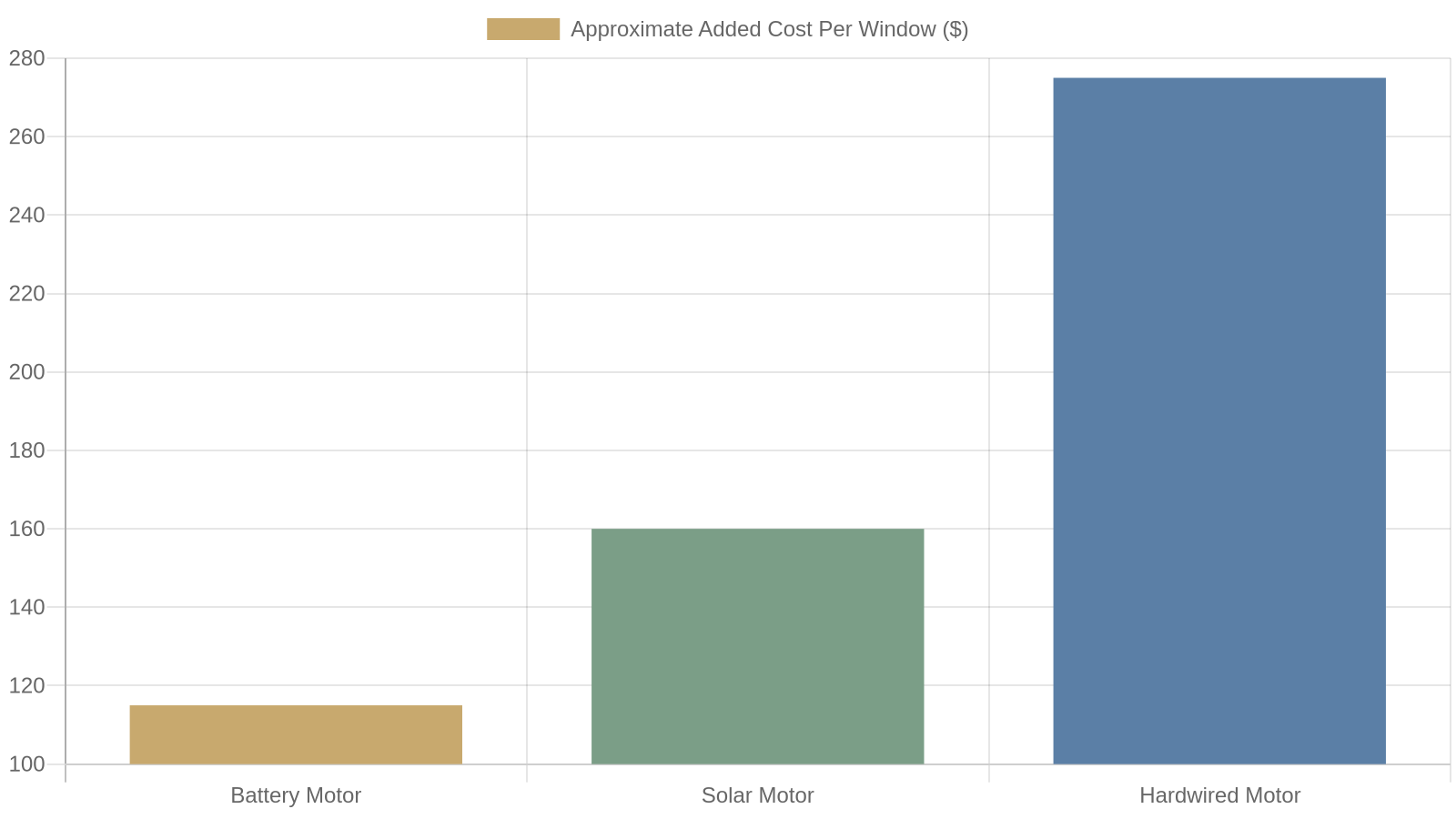
Battery motors are the most installation-friendly option — no electrician required, no wall penetrations, no disruption to existing trim or drywall. Modern lithium-ion battery packs typically power a large motorized shade through 1,000–1,500 full open/close cycles before needing a recharge. For a window operated twice daily, that translates to roughly 18–24 months between charges. Recharging is simple: a USB-C cable connects directly to the motor housing. The trade-off is that very wide, heavy shades (over 100 inches wide with dense blackout fabric) draw more power and may require recharging every 8–12 months. Battery motors add approximately $80–$150 to the cost of a manual shade motor, making them the most budget-accessible motorized entry point.
Hardwired (AC) Motors
Hardwired motors connect directly to your home’s 120V electrical system, providing unlimited, uninterrupted power regardless of shade size or usage frequency. They are the preferred choice for very large or heavy window treatments — think motorized wood blinds on a 96-inch-wide window, or dual-roller systems with both a sheer and a blackout layer. Installation requires a licensed electrician to run low-voltage or line-voltage wiring to each headrail location, typically adding $75–$200 per window to the project cost. Once installed, hardwired systems are completely maintenance-free on the power side and integrate most reliably with whole-home automation systems like Control4, Savant, or Lutron RadioRA.
Solar-Powered Motors
Solar motors occupy a clever middle ground: a small photovoltaic panel — typically 2–4 inches wide — mounts at the top of the window frame and trickle-charges an internal battery throughout the day. In Jackson, TN’s sun-rich climate (averaging 213 sunny days per year), solar motors on south- and west-facing windows rarely need supplemental charging. They are an excellent choice for sunrooms, enclosed porches, and any window where running electrical wire would be disruptive or cost-prohibitive. Solar motors cost roughly $120–$200 more than a comparable battery motor but eliminate the need for periodic manual recharging.
3. Control Systems: Remote, App, and Voice Control Options
One of the biggest decisions when specifying motorized blinds for large windows is choosing how you want to control them day to day. Control options range from simple handheld remotes to full smart-home ecosystem integration, and the right choice depends on your household’s tech comfort level and existing infrastructure.
Dedicated Remote Controls
Every motorized blind system ships with at least one dedicated RF (radio frequency) remote. Unlike older IR remotes that required line-of-sight, RF remotes work through walls and from across the room — essential in open-plan Jackson homes where the window may be 30 feet from the sofa. Single-channel remotes control one shade; multi-channel remotes (5-, 10-, or 15-channel) let you operate each window independently or group them for one-touch whole-room control. Most quality remotes have a range of 50–65 feet, more than enough for even the largest great rooms. Remotes are included in the base system price and require no Wi-Fi or smart-home hub.
Smartphone App Control
Wi-Fi-enabled motor bridges or built-in Wi-Fi motors connect your shades to a manufacturer app (Somfy TaHoma, Lutron app, Hunter Douglas PowerView, etc.), allowing control from anywhere with an internet connection. Forgot to close the shades before leaving for work? Open the app and lower them from downtown Jackson in seconds. App control also enables scheduling: program shades to lower automatically at 2 p.m. on summer weekdays when the western sun hits hardest, then rise again at 5 p.m. A Wi-Fi bridge typically costs $80–$150 and supports up to 30 shades, making it a cost-effective hub for whole-home deployments.
Voice and Smart-Home Integration
Most major motorized blind platforms now offer native integration with Amazon Alexa, Google Home, and Apple HomeKit. Once linked, voice commands like “Alexa, lower the living room shades to 50%” work reliably. For deeper automation — triggering shades based on a smart thermostat reading, a sunrise/sunset schedule, or a security system event — systems like Lutron RadioRA 3, Control4, or SmartThings provide robust rule-building. Lutron’s Serena and Sivoia lines are particularly popular in Jackson-area new construction because they integrate seamlessly with Lutron lighting dimmers already specified by many local builders, creating a unified smart-home experience without a separate hub.
4. How to Measure Large Windows for Motorized Blinds

Getting the measurements right is the most critical step in any large-window motorized blind project. Errors that are minor inconveniences on a 36-inch window become expensive problems on a 96-inch one. Here’s what you need to know before ordering.
Inside Mount vs. Outside Mount
For large windows, the mount decision matters more than it does for standard sizes. An inside mount tucks the headrail into the window frame opening, creating a clean, built-in look — but it requires a minimum frame depth of 2.5 inches (3.5 inches is ideal for motorized headrails, which are slightly deeper than manual ones). An outside mount positions the headrail above the window frame on the wall, allowing the shade to cover the full glass area plus a few inches of surrounding trim. Outside mounts are often preferred on large windows because they can make the window appear taller and wider, and they provide complete light blockage at the edges — critical for media rooms and bedrooms in Jackson’s bright summers.
Width Limits and Seaming
Most motorized roller shade fabrics can be fabricated up to 144 inches (12 feet) wide as a single piece — but motors at that width must be carefully matched to the fabric weight. Very wide shades with dense blackout fabric may require a higher-torque motor, which adds $50–$100 to the unit cost. Windows wider than 144 inches typically require a two-shade split configuration, with two independent motorized shades meeting at the center. This approach actually offers a design advantage: each shade can be controlled independently for asymmetric light control, or grouped to operate simultaneously. A professional measurer will assess your specific window dimensions and recommend the optimal configuration.
Why Professional Measuring Matters
A measurement error of even ¼ inch on a large window can mean a shade that gaps at the sides, binds in the frame, or — worst of all — must be remade at significant cost. Professional measuring accounts for out-of-square frames (common in older West Tennessee homes), window sill depth, trim projection, and the precise headrail clearance required for motorized hardware. Blinds Galore’s free in-home consultation includes professional measuring at no charge, eliminating the guesswork entirely and ensuring your motorized blinds fit perfectly the first time.
5. Cost Breakdown: What to Budget for Motorized Blinds on Large Windows

Budget is almost always the first question homeowners ask when exploring motorized blinds for large windows. The honest answer: costs vary widely based on product type, motor technology, and window size — but the investment is more accessible than most people expect, especially when energy savings are factored in.
Per-Window Cost Ranges
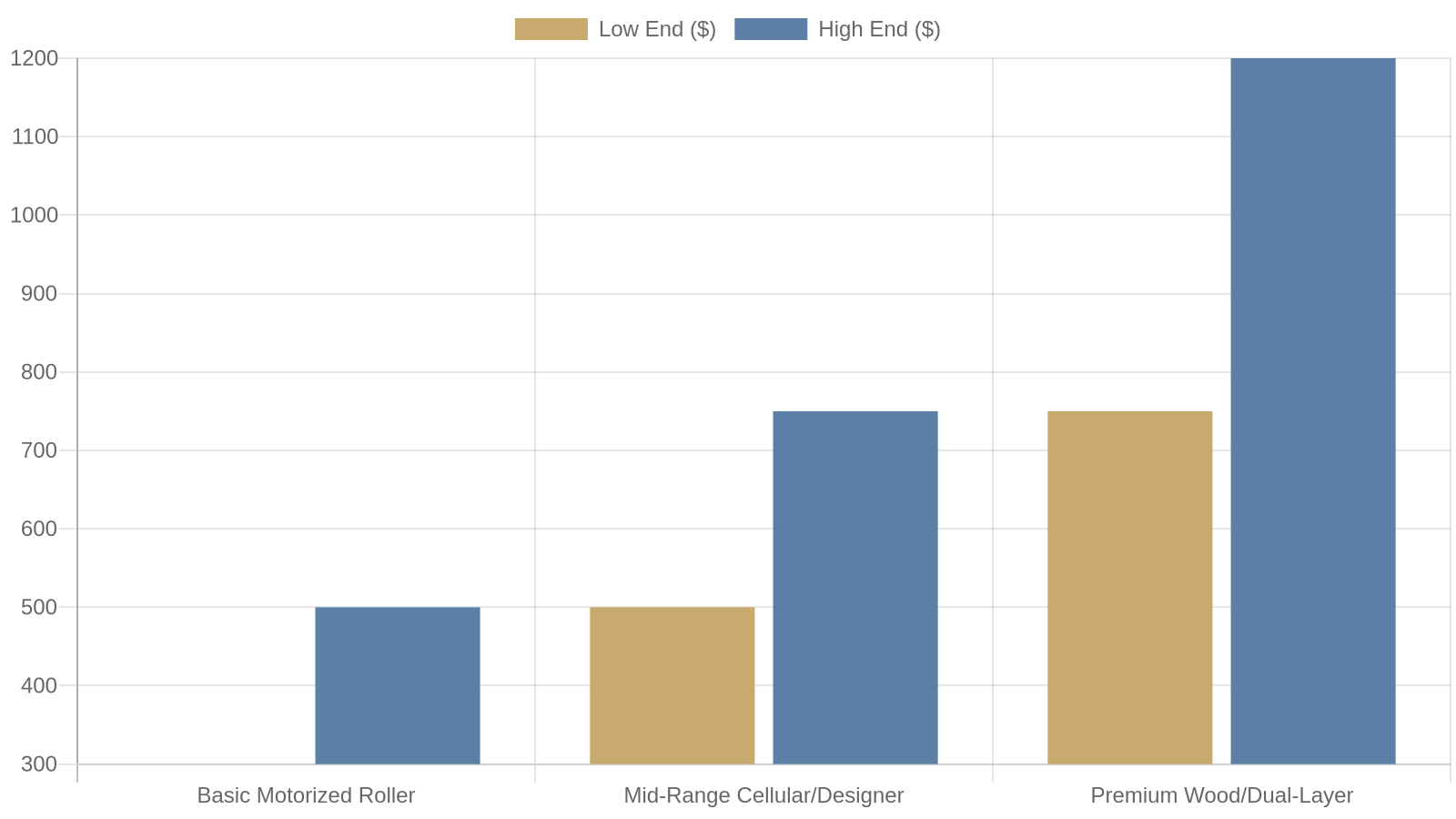
Motorized blind pricing for large windows in the Jackson, TN market generally breaks down as follows. A basic motorized roller shade (battery motor, standard fabric, remote control) on a window 72–96 inches wide runs approximately $300–$500 per window. A mid-range motorized cellular or designer roller shade with app control and a solar or hardwired motor typically falls in the $500–$750 range. Premium systems — motorized wood or faux-wood blinds, dual-layer roller systems, or full Lutron integration — on windows 96–144 inches wide can reach $750–$1,200 per window installed. These figures include the shade, motor, remote, and standard professional installation.
What Drives the Price Up (or Down)
Several variables move the needle significantly. Fabric choice is the biggest single factor: a sheer solar screen costs 30–50% less than a premium woven wood or blackout fabric at the same width. Motor brand matters too — Somfy and Lutron motors carry a premium of $80–$200 over generic motors but offer superior reliability, quieter operation, and better smart-home integration. Window quantity works in your favor: most installers, including Blinds Galore, offer volume pricing when outfitting multiple rooms, so a whole-home project costs proportionally less per window than a single-window order. Finally, installation complexity — high ceilings requiring scaffolding, or hardwired motors needing an electrician — adds to the total.
Energy Savings That Offset the Investment
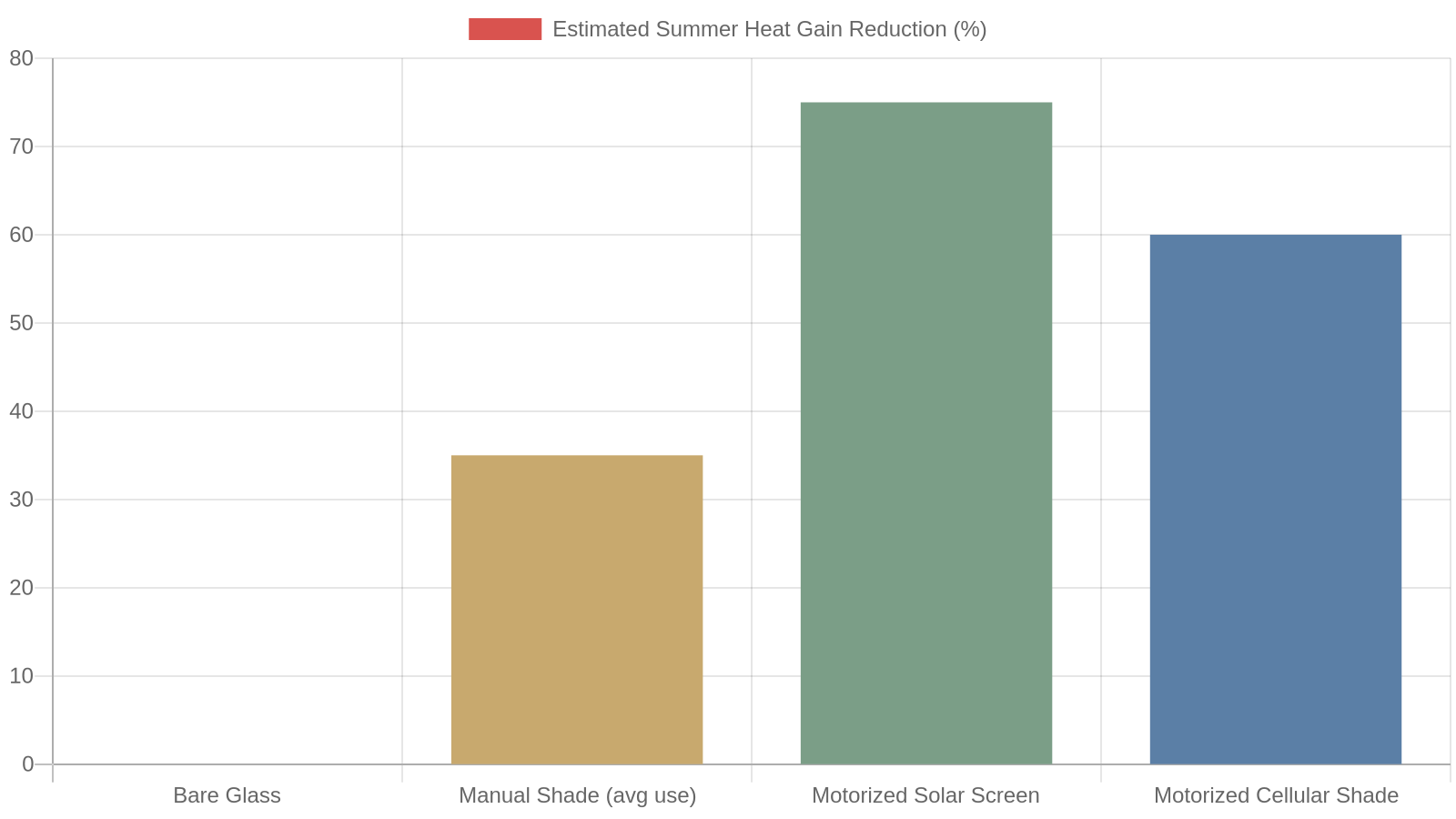
Motorized blinds on large windows aren’t just a comfort upgrade — they’re an energy investment. The U.S. Department of Energy estimates that properly managed window coverings can reduce heat gain through windows by up to 77% in summer. For a Jackson, TN home with 400 square feet of south- and west-facing glass, automated shades that lower during peak afternoon hours could realistically reduce cooling costs by $15–$40 per month during the June–September peak season. Over a 10-year product lifespan, that’s $1,800–$4,800 in cumulative savings — often exceeding the initial investment on large-window installations.
6. Top Motorized Blind Brands Worth Knowing

Not all motorized blind systems are created equal. The brand you choose determines motor reliability, smart-home compatibility, warranty coverage, and the long-term availability of replacement parts. These three brands consistently lead the market for large-window motorized applications.
Somfy: The Motor Specialist
Somfy is the world’s largest manufacturer of motorized blind and shutter motors, and their products are specified by window treatment dealers across the country for good reason. Somfy’s RTS (Radio Technology Somfy) and newer io-homecontrol platforms offer exceptional reliability, a 5-year motor warranty, and compatibility with virtually every major smart-home ecosystem. Their Sonesse motor line — designed specifically for large, heavy window treatments — operates at just 32 dB, quieter than a whispered conversation. For Jackson homeowners investing in a whole-home motorized system, Somfy motors provide the confidence of a globally proven platform backed by local dealer support.
Lutron: The Smart-Home Integration Leader
Lutron’s Serena and Sivoia QS lines are the gold standard for smart-home integration. Their proprietary Clear Connect RF technology operates on a dedicated frequency that doesn’t compete with Wi-Fi or Bluetooth, making it exceptionally reliable in large homes where signal interference is a concern. Lutron shades integrate natively with Apple HomeKit, Amazon Alexa, Google Home, and Lutron’s own lighting dimmers — a significant advantage for homeowners who already use Lutron switches. The Serena line targets the mid-range market ($350–$700 per window installed), while Sivoia QS serves luxury new construction and whole-home automation projects.
Hunter Douglas PowerView: Premium Fabric Meets Smart Tech
Hunter Douglas is renowned for fabric quality and design variety, and their PowerView motorization platform brings that reputation into the smart-home era. PowerView Gen 3 uses a dedicated Pebble remote and a Wi-Fi hub to enable scheduling, scene creation, and integration with Alexa, Google, and HomeKit. Hunter Douglas’s proprietary fabrics — Duette honeycomb, Silhouette, Luminette — are available in hundreds of textures and colors, making PowerView the preferred choice for design-forward Jackson homeowners who want motorization without sacrificing aesthetic options. Expect to invest $500–$1,000+ per large window for a complete Hunter Douglas PowerView installation.
7. Motorized Blinds vs. Manual Blinds for Large Windows

Homeowners weighing the motorized upgrade often ask a straightforward question: is it really worth the extra cost compared to a quality manual blind? For large windows specifically, the answer is almost always yes — and the reasons go beyond simple convenience.
Convenience and Daily Usability
The usability gap between motorized and manual blinds widens dramatically as window size increases. On a standard 36-inch window, pulling a cord or turning a wand takes two seconds. On a 96-inch motorized roller shade, the same operation — reaching across a wide span, applying even tension to avoid crooked rolling — takes considerably longer and often results in uneven positioning. Motorized systems eliminate this entirely: one button press lowers all your large windows simultaneously to a precise, repeatable position. For households with mobility limitations, this difference is transformative. For busy families in Jackson, TN, it’s simply a daily quality-of-life upgrade that pays dividends every single morning and evening.
Child Safety and Cord-Free Design
Corded window coverings are a documented safety hazard. The Consumer Product Safety Commission (CPSC) estimates that approximately 8 children die each year from window cord strangulation in the U.S., and the industry has been moving toward cordless and motorized designs as the safety standard. Motorized blinds are inherently cordless — there is nothing for a child or pet to reach, pull, or become entangled in. For Jackson families with young children or pets, motorized large-window treatments aren’t just convenient; they provide genuine peace of mind that no manual corded system can match.
Motorized Blind Options for Large Windows: 6-Point Comparison
Use this table to quickly compare the most common motorized blind types for large windows across the factors that matter most to Jackson, TN homeowners.
8. Energy Efficiency and Light Control for West Tennessee Homes
For Jackson, TN homeowners, energy efficiency is one of the most compelling practical arguments for motorized blinds on large windows. The combination of the right fabric and automated scheduling can make a measurable difference on monthly utility bills — in both summer and winter.
Blocking Summer Heat Gain
West Tennessee summers are no joke. Jackson, TN averages 38 days per year above 90°F, and south- and west-facing windows can become significant heat sources by early afternoon. Solar screen roller shades with a 3% openness factor block approximately 95% of solar radiation while preserving outward views. Motorized automation takes this further: program shades to lower automatically when interior temperatures exceed 78°F, or simply schedule them to close at noon on summer days when the sun angle is most direct. The Lawrence Berkeley National Laboratory found that automated interior shades can reduce cooling energy use by 20–45% in hot climates — a meaningful saving on a West Tennessee utility bill.
Winter Insulation Benefits
Large windows lose heat rapidly in winter, and Jackson’s January average low of 32°F means heating costs matter. Motorized cellular shades with a double- or triple-cell honeycomb construction create trapped air pockets that act as insulation, improving a window’s effective R-value from roughly R-1 (bare single-pane glass) to R-3 or R-4. Scheduling these shades to lower automatically at sunset and rise at sunrise captures solar heat gain during the day while insulating against nighttime cold — a passive energy strategy that requires zero daily effort from the homeowner once the automation is configured.
Glare Control Without Sacrificing Views
One of the most common complaints about large windows is glare on television screens and computer monitors. Manual blinds are often left fully closed to solve this problem — which defeats the purpose of having beautiful windows. Motorized solar screens offer a more nuanced solution: lower the shade to 40% of the window height to block the direct glare angle while leaving the upper portion of the glass open for natural light and views. Motorized systems hold these intermediate positions precisely and repeatably, something that’s nearly impossible to achieve consistently with manual operation on a large window.
9. Installation: What the Process Looks Like
Understanding the installation process helps set realistic expectations and ensures the project goes smoothly. For large-window motorized systems, professional installation isn’t optional — it’s essential for proper motor programming, precise leveling, and long-term reliability.
The Consultation and Measuring Visit
A professional motorized blind installation begins with an in-home consultation — not a showroom visit. A specialist comes to your Jackson, TN home, assesses each large window’s dimensions, mount options, existing electrical access, and your preferred control system. They’ll discuss fabric samples in your actual lighting conditions (a huge advantage over choosing fabric under showroom fluorescents), confirm motor type recommendations based on window size and usage patterns, and provide a detailed written quote. This visit typically takes 45–90 minutes for a multi-room project and costs nothing with Blinds Galore’s free in-home consultation service.
Fabrication and Lead Times
Custom motorized blinds for large windows are built to order — there are no off-the-shelf options at the dimensions most Jackson-area homes require. Standard fabrication lead times run 3–6 weeks depending on the brand and current production schedules. Rush options are sometimes available for an additional fee. During this window, any hardwired electrical work can be completed by a licensed electrician so the installation appointment is efficient. Battery and solar motor systems require no pre-wiring and can be installed immediately upon product arrival.
The Installation Day
Professional installation of motorized blinds on large windows typically takes 1–3 hours per room, depending on window count and motor type. Installers mount the headrail brackets, hang and level the shade, connect or insert the motor power source, and program the remote and limit stops (the precise open and closed positions the motor returns to every time). For app-controlled systems, the installer will connect the Wi-Fi bridge and walk you through the app setup before leaving. A quality installer will also demonstrate every control method — remote, app, and voice — and leave you confident in operating your new system independently.
10. Motorized Blinds for Specialty Large Windows
Not every large window is a standard rectangle. Jackson, TN homes feature a wide range of specialty window configurations that benefit from motorization even more than standard windows — because manual operation on these windows ranges from inconvenient to genuinely impossible.
Skylights and Angled Windows
Skylights and angled clerestory windows are among the most difficult window types to treat manually — and among the easiest to justify motorizing. Reaching a skylight requires a ladder every time, making manual operation impractical for daily use. Motorized cellular shades designed for sloped and overhead glazing mount directly to the window frame and travel on side channels that keep the shade taut regardless of angle. In Jackson’s summer heat, an unshaded skylight can raise room temperature significantly; a motorized shade that closes automatically during peak hours solves the problem without any daily effort.
Two-Story and Great Room Windows
Two-story great room windows — those dramatic floor-to-ceiling glass walls that define many newer Jackson-area homes — are virtually impossible to treat manually without a very long pole or a ladder. Motorized roller shades or drapery systems on these windows are the only practical daily-use solution. Shade widths up to 144 inches and heights up to 180 inches are achievable with the right motor and fabric combination. For windows exceeding these dimensions, a two-shade split configuration (side by side) or a stacked panel track system provides complete coverage with independent zone control.
Sliding Glass Doors and Wide Openings
Sliding glass doors — a staple of West Tennessee ranch homes and sunrooms — present a unique challenge: the treatment must clear the door’s travel path when open, yet provide complete coverage when closed. Motorized panel track systems are ideal here, with panels that stack neatly to one side on command. Alternatively, motorized roller shades on sliding doors can be programmed to raise fully when the door is in use and lower to any position when closed. For wider openings (96 inches and beyond), a split two-shade configuration allows one panel to remain down while the other is raised for door access — a level of flexibility no manual system can match.
Ready to Upgrade Your Large Windows? Here's Your Next Move
Motorized blinds for large windows are one of the highest-impact upgrades a Jackson, TN homeowner can make — combining daily convenience, energy savings, child safety, and smart-home integration in a single investment. The key is getting the product selection, motor type, and measurements right from the start, which is exactly what a professional in-home consultation delivers.
Start with a Free In-Home Consultation
The single best thing you can do before spending a dollar on motorized blinds for large windows is to schedule a free in-home consultation with a local specialist. Seeing your actual windows — their dimensions, orientation, existing trim, and the quality of light at different times of day — makes every recommendation more accurate and every quote more reliable. Blinds Galore has served Jackson, TN and surrounding communities including Lexington, Henderson, and Milan for over 18 years, and every project begins with a no-obligation, no-pressure home visit. Call (731) 571-5179 to schedule yours, or visit Blinds Galore online to learn more about our full range of custom motorized blinds, shades, and shutters.
Our 100% Satisfaction Guarantee
Every motorized blind system Blinds Galore installs is backed by a 100% satisfaction guarantee. If something isn’t right — the fit, the fabric, the operation — we make it right. For large-window projects where the investment is meaningful, that guarantee isn’t just a marketing phrase; it’s the assurance that you’re working with a team that stands behind its work long after installation day. We also offer custom shades and custom-built shutters if motorized blinds aren’t the right fit for every window in your home — our specialists will help you find the best solution for each space.
Frequently Asked Questions
How much do motorized blinds cost for large windows in Jackson, TN?
Motorized blinds for large windows in Jackson, TN typically cost between $300 and $1,200 per window installed, depending on the product type, fabric, motor technology, and window dimensions. Basic motorized roller shades start around $300, while premium dual-layer or wood blind systems on very wide windows can reach $1,200 or more.
Do motorized blinds work without Wi-Fi?
Yes. All motorized blind systems include a dedicated RF remote control that works without Wi-Fi or a smart-home hub. Wi-Fi connectivity is an optional add-on that enables smartphone app control and voice assistant integration, but the core motorized function operates independently of your internet connection.
How long do battery-powered motorized blinds last between charges?
Most battery-powered motorized blinds last 1,000–1,500 open/close cycles per charge. For a large window operated twice daily, that translates to roughly 18–24 months of use before recharging is needed. Recharging typically takes 4–6 hours via a USB-C cable connected directly to the motor.
Can motorized blinds be installed on very wide windows over 100 inches?
Yes. Single motorized roller shades can be fabricated up to 144 inches wide. For windows wider than 144 inches, a two-shade split configuration — two independent motorized shades meeting at the center — provides complete coverage. Both shades can be controlled simultaneously or independently.
Are motorized blinds worth the extra cost over manual blinds?
For large windows specifically, motorized blinds are almost always worth the investment. They eliminate the reach and leveling challenges of manual operation, provide child-safe cordless design, enable energy-saving automation, and add smart-home convenience. Energy savings of $15–$40 per month during West Tennessee's peak summer season can offset the cost difference over time.
Does Blinds Galore offer free measuring and installation in Jackson, TN?
Yes. Blinds Galore offers free in-home consultations that include professional measuring at no charge for homeowners in Jackson, TN and surrounding communities including Lexington, Henderson, and Milan. Call (731) 571-5179 to schedule your visit.
You might also like
Faux Wood vs. Real Wood Blinds: Durability and Cost Compared for Jackson, TN Homes
Quick answer: Faux wood blinds typically cost $20–$60 per window less than real wood and outperform
7 Best Motorized Cellular Shades for Large Windows in Jackson, TN
Quick answer: Motorized cellular shades are the top choice for large windows in Jackson, TN homes because

9 Reasons to Choose Blinds Galore for West Tennessee Window Treatments
Quick answer: Blinds Galore is West Tennessee's go-to source for custom blinds, shades, and plantation

10 Best Custom Shades for Jackson TN Nurseries and Kids’ Rooms
Quick answer: For Jackson, TN nurseries and children's rooms, the safest and most durable custom

How to Contact Blinds Galore Jackson TN for a Free In-Home Consultation
Quick answer: Contacting Blinds Galore in Jackson, TN is simple: call (731) 571-5179 or submit a request

7 Best Custom Shades for Pet-Friendly Homes in Jackson, Tennessee
Quick answer: For pet-friendly homes in Jackson, Tennessee, the best custom shades combine durability,